
Good King Wenceslas is the gentlest carol in our Christmas collection, and the interactive player below is the fastest way to learn it: hear it at half speed, watch the notes and keys light up as they play, and drag the score to repeat any bar. The sheet music, fingering for both hands, and a free printable PDF follow.
Learn it with the interactive player
- Slow it down: x0.5 or x0.75 while you learn the notes, back to x1 once they flow.
- Pause anywhere: the current keys stay lit so you can find them on your own piano.
- Drag the score left or right, or use the 15s buttons, to replay a phrase.
The sheet music, section by section

Section A is two identical four-bar phrases in G position: three repeated C5s with finger 4, a step up to D5, then a long G4 under the thumb before A4-G4-A4-B4 walks into two half-note C5s. Set the player to x0.5 and learn four measures; the next four are the same.

Section B climbs to the top: the hand moves to C5 position and walks G5-F5-E5-D5 with 5-4-3-2, returns to G position for the poor man, then repeats the high walk into the C5-F5 swell and the final whole-note C5. Loop the two position jumps at x0.75 before running the whole line.
The full score
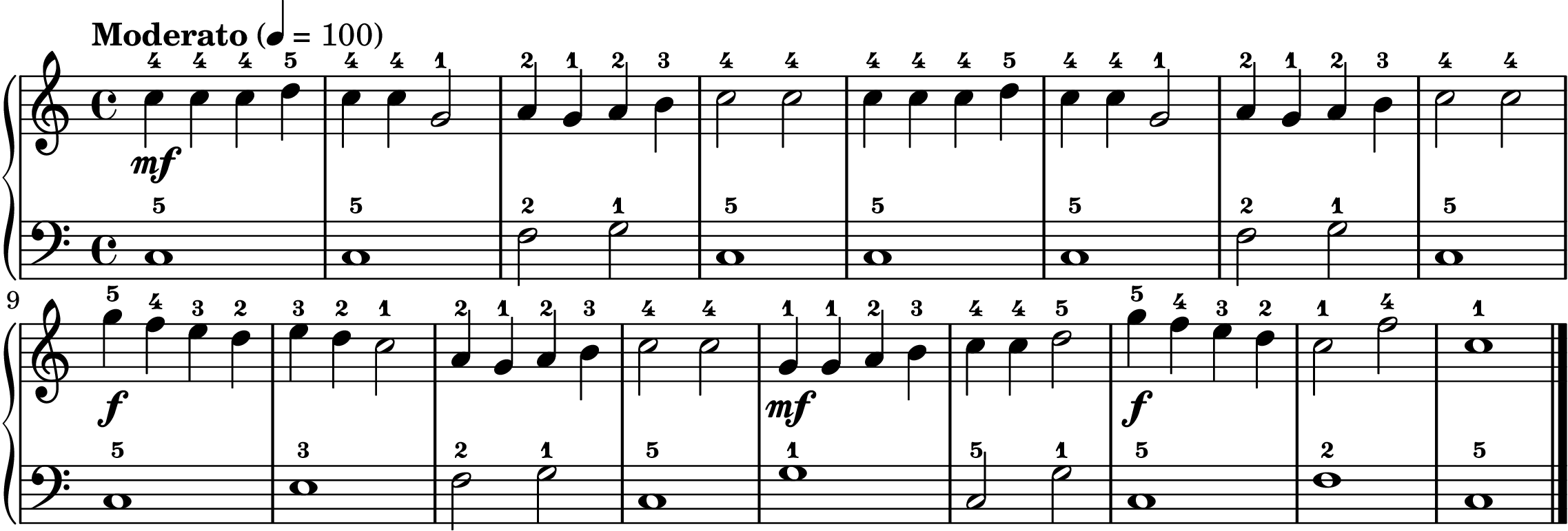
In the full score the left hand plays almost nothing but whole notes on C3, so keep your eyes on the right hand and let the F3-G3 half notes under the Feast of Stephen line be your one cue. Build from 70 toward the 100 BPM Moderato.
Note by note: keys and fingering
- Right hand: G position for most of the carol: thumb (1) on G4, index (2) on A4, middle (3) on B4, ring (4) on C5 and pinky (5) on D5. For the bright moon line the hand steps up to C5 position, thumb on C5 and pinky reaching G5.
- Left hand: Pinky (5) on C3 for the whole piece, with middle (3) on E3, index (2) on F3 and thumb (1) on G3: mostly whole notes, plus F3-G3 half-note pairs under the Feast of Stephen line.
| Note | On the Staff | On the Keyboard | Finger |
|---|---|---|---|
| G4 | Second line of treble staff | White key between the first two of three black keys above middle C | RH Thumb (1) |
| A4 | Second space of treble staff | White key between the last two of three black keys above middle C | RH Index (2) |
| B4 | Middle line of treble staff | White key right of the three black keys above middle C | RH Middle (3) |
| C5 | Third space of treble staff | One octave above middle C | RH Ring (4) |
| D5 | Fourth line of treble staff | White key between the two black keys above C5 | RH Pinky (5) |
| E5 | Fourth space of treble staff | White key right of the two black keys above C5 | RH Middle (3) |
| F5 | Top line of treble staff | White key left of the three black keys above C5 | RH Ring (4) |
| G5 | Space just above the treble staff | White key between the first two of three black keys above C5 | RH Pinky (5) |
| C3 | Second space of bass staff | One octave below middle C | LH Pinky (5) |
| E3 | Third space of bass staff | White key right of the two black keys below middle C | LH Middle (3) |
| F3 | Fourth line of bass staff | White key left of the three black keys below middle C | LH Index (2) |
| G3 | Fourth space of bass staff | White key between the first two of three black keys below middle C | LH Thumb (1) |
Prefer a video? Watch the keys light up
Same color code as the player: green marks the right hand, blue the left hand, with the score and keyboard in one vertical video.
The story behind Good King Wenceslas
The melody of Good King Wenceslas is six centuries older than its words: it started life as Tempus adest floridum, a 13th century spring carol that was printed in the Finnish collection Piae Cantiones in 1582. In 1853 the English hymn writer John Mason Neale gave the tune new lyrics about Wenceslas, a real 10th century Duke of Bohemia remembered for his kindness, who walks through deep snow on the day after Christmas to bring food and firewood to a poor man. Nearly every note repeats or moves by step, which makes it an ideal first Christmas piece. The last line even adds an extra measure for the held fu-el, a small surprise that has belonged to the tune since medieval times.
Get the printable PDF
The printable PDF of Good King Wenceslas - full score, hand positions, and a step-by-step practice guide - ships inside our free Christmas pack together with fourteen other carols.
A carol that stays in one hand position is the perfect moment to check your seat height, and an Adjustable Piano Bench with Back Support makes that adjustment a two-second job.
Piano teacher? Track your students' practice. Join the early list
FAQ
How hard is Good King Wenceslas on piano?
It is one of the easiest pieces in Level 1 of our Christmas collection. The right hand sits in G position for most of the carol with one step up to C5 position for the bright moon line, and the left hand plays whole notes on C3 almost throughout.
How long does it take to learn Good King Wenceslas?
Most beginners have the first eight bars in a couple of days, because measures 5-8 repeat measures 1-4 exactly. Allow a week or two for the two position jumps in the second half and for playing all 17 measures hands together at 100 BPM.
What level is Good King Wenceslas?
Level 1 of our Christmas collection. It is in C major, 4/4, Moderato at 100 BPM, with a five-finger right hand, no accidentals and a left hand of single whole and half notes on C3, E3, F3 and G3.
What are the notes for Good King Wenceslas?
The melody starts C5, C5, C5, D5, then C5, C5 and a long G4, followed by A4, G4, A4, B4 into two half-note C5s. The high line runs G5, F5, E5, D5. The left hand holds C3 under most bars with F3 and G3 half notes in the third measure; see the full note-by-note table above.