
This Is My Father’s World is a quiet thank-you for the whole world, and this easy C major arrangement is built around the interactive player below: hear it at half speed, watch the notes and keys light up, and drag the score to replay any phrase. The sheet music, fingering for both hands, and a free printable PDF come next.
Learn it with the interactive player
- Slow it down: x0.5 or x0.75 while you learn the notes, back to x1 once they flow.
- Pause anywhere: the current keys stay lit so you can find them on your own piano.
- Drag the score left or right, or use the 15s buttons, to replay a phrase.
The sheet music, section by section

Set the player to x0.5 for Section A (upbeat plus measures 1-8): a slurred pair of pickup eighths C4-D4 leads into E4-G4-E4-D4 and a long C4, then the line rises to A4 on listening ears. In measure 6 comes the surprise: The dips all the way down to G3 below middle C, and music of the spheres climbs back up C4-D4-E4-G4 to rest on middle C.
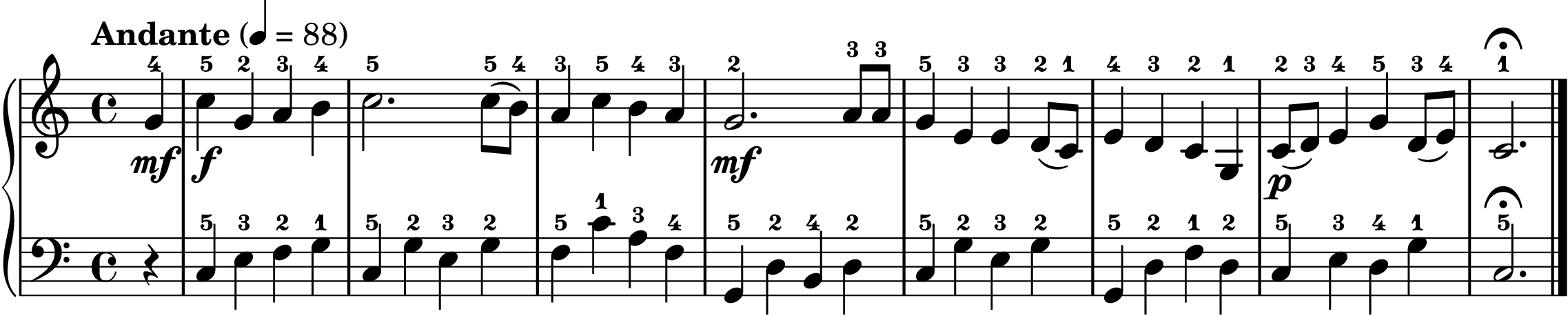
Section B (upbeat plus measures 9-16) lifts the melody an octave: This is my Father's world now starts on C5, with the left hand climbing C3-E3-F3-G3 in parallel tenths underneath, the most beautiful bar of the piece. After the thought, a long G4, the rocks-and-trees line revisits the low dip to G3, and wrought settles on middle C under a fermata.
The full score
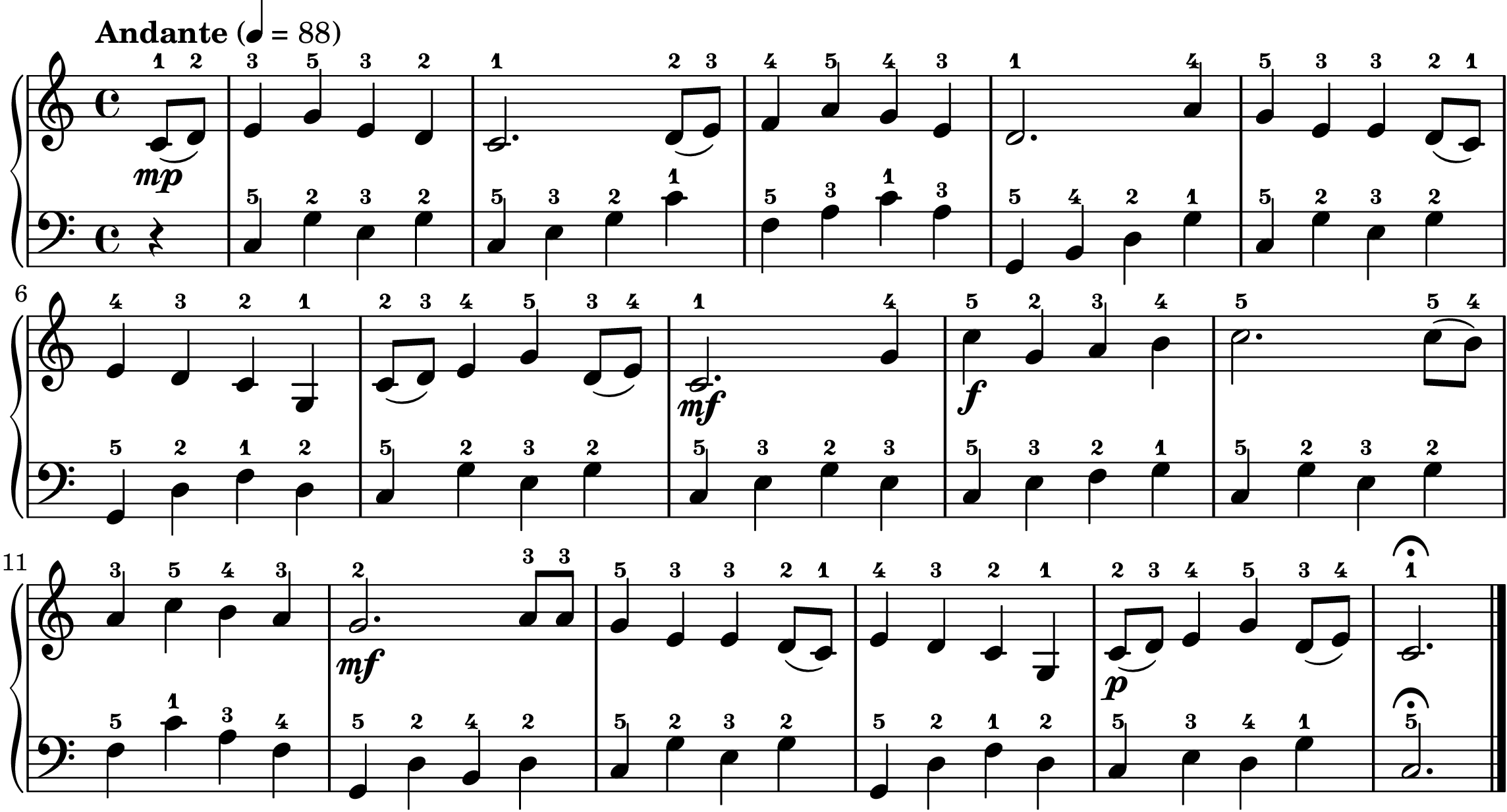
In the full score, learn measure 9 first as a duet with yourself, both hands moving on every beat, then assemble the rest around it: keep every paired-eighth pickup light, let measures 9-11 be the forte crest, and settle at 88 BPM with room to broaden in the last measure.
Note by note: keys and fingering
- Right hand: Centered on C position at middle C with the thumb (1) on C4 and the pinky (5) on G4, with character at both ends: the melody dips below the staff to G3 on The and His, reached by the thumb, and lifts to C5 with the pinky when This is my Father's world returns on high. Paired eighth notes open almost every phrase.
- Left hand: Flowing quarter-note broken chords, pinky (5) on the bass note: C (C3-G3-E3-G3 with 5-2-3-2), F (F3-A3-C4), G (G2-B2-D3-G3). In measure 9 the bass walks C3-E3-F3-G3 with 5-3-2-1 in parallel tenths with the rising melody.
| Note | On the Staff | On the Keyboard | Finger |
|---|---|---|---|
| G3 | Below the staff, under middle C | Four white keys below middle C | RH Thumb (1) |
| C4 | Ledger line below treble staff | Middle C | RH Thumb (1) |
| D4 | Just below the bottom line | Right of middle C | RH Index (2) |
| E4 | Bottom line of treble staff | Two white keys above middle C | RH Middle (3) |
| F4 | First space of treble staff | Left of the three black keys | RH Ring (4) |
| G4 | Second line of treble staff | Between first two black keys | RH Pinky (5) |
| A4 | Second space of treble staff | Between last two black keys | RH Pinky (5) |
| B4 | Middle line of treble staff | Right of three black keys | RH Ring (4) |
| C5 | Third space of treble staff | One octave above middle C | RH Pinky (5) |
| G2 | Bottom line of bass staff | Second G below middle C | LH Pinky (5) |
| B2 | Second line of bass staff | Right of three black keys, below C3 | LH Ring (4) |
| C3 | Second space of bass staff | One octave below middle C | LH Pinky (5) |
| D3 | Third line of bass staff | Between the two black keys below middle C | LH Index (2) |
| E3 | Third space of bass staff | Right of two black keys | LH Middle (3) |
| F3 | Fourth line of bass staff | Left of three black keys | LH Pinky (5) |
| G3 | Fourth space of bass staff | Between first two black keys | LH Index (2) |
| A3 | Top line of bass staff | Between last two of three black keys, below middle C | LH Middle (3) |
| C4 | Ledger line above bass staff | Middle C | LH Thumb (1) |
Prefer a video? Watch the keys light up
Same color code as the player: green marks the right hand, blue the left hand, with the score and keyboard in one vertical video.
The story behind This Is My Father's World
Pastor Maltbie Babcock loved to hike the hills above Lake Ontario, telling his wife he was going out to see my Father's world. After his death his poem of that name was published, and in 1915 his lifelong friend Franklin Sheppard matched it to an English melody he remembered his mother singing to him as a boy. He named the tune Terra Beata, Latin for blessed earth. It is a hymn of gratitude for rocks and trees, skies and seas, and birdsong, which makes it a natural closing word for a Thanksgiving songbook: a quiet thank-you for the whole world. This arrangement keeps the melody around middle C, with its dip to low G3, over flowing single-note broken chords.
Get the printable PDF
The printable PDF of This Is My Father's World - full score, hand positions, and a step-by-step practice guide - ships inside our free Thanksgiving pack together with fourteen other Thanksgiving pieces.
The parallel tenths in measure 9 come out evenly when both arms hang at the same relaxed height, and an Adjustable Piano Bench with Back Support makes that easy to set.
Piano teacher? Track your students' practice. Join the early list
FAQ
How hard is This Is My Father's World on piano?
It is a Level 3 piece in our Thanksgiving collection. The right hand is centered on C position at middle C but reaches down to G3 and up to C5, with slurred eighth-note pickups before most phrases, and the left hand plays flowing quarter-note broken chords in single notes, including a walking line in parallel tenths in measure 9.
How long does it take to learn This Is My Father's World?
Three to four weeks. The melody itself is gentle, but the left hand moves on every beat, the dip to G3 needs a controlled stretch of the thumb, and measure 9, where both hands walk together, deserves its own slow practice before the rest is assembled.
What level is This Is My Father's World?
Level 3 of our Thanksgiving collection. It introduces a melody that ranges beyond one position in both directions, slurred paired eighths as upbeats, a continuous broken-chord bass, dynamic shaping from piano to forte, and hands that move together in parallel tenths.
What are the notes for This Is My Father's World?
The melody starts with the slurred pickup C4, D4, then E4, G4, E4, D4, a long C4, D4, E4, F4, A4, G4, E4, a long D4, A4, G4, E4, E4, D4, C4, then E4, D4, C4 dipping to G3, and climbs C4, D4, E4, G4, D4, E4 to middle C. Measure 9 begins the high return C5, G4, A4, B4, C5. The bass rolls C3-G3-E3-G3. See the full table above.