
Home on the Range is the anthem of the American prairie, and this easy C major waltz arrangement is built around the interactive player below: hear it at half speed, watch the notes and keys light up, and drag the score to replay the leaps. The sheet music, fingering for both hands, and a free printable PDF come next.
Learn it with the interactive player
- Slow it down: x0.5 or x0.75 while you learn the notes, back to x1 once they flow.
- Pause anywhere: the current keys stay lit so you can find them on your own piano.
- Drag the score left or right, or use the 15s buttons, to replay a phrase.
The sheet music, section by section

Set the player to x0.5 for Section A (upbeat plus measures 1-8): Oh, give me a home strolls up G4-C5-D5 to a long E5, then buffalo vaults from A4 to two F5s in measure 3. Deer crowns the phrase on a forte dotted-quarter G5 in measure 5 before tumbling down to repeated C5s, and play hangs on a tied D5 while the waltz bass keeps turning underneath.

Section B (upbeat plus measures 9-16) repeats the buffalo music for where seldom is heard a discouraging word, pushes to forte on the repeated F5s of measure 12, then skies are not cloudy glides E5-D5-C5 with 4-3-2 and the tune settles on a long, quiet C5 under a fermata.
The full score
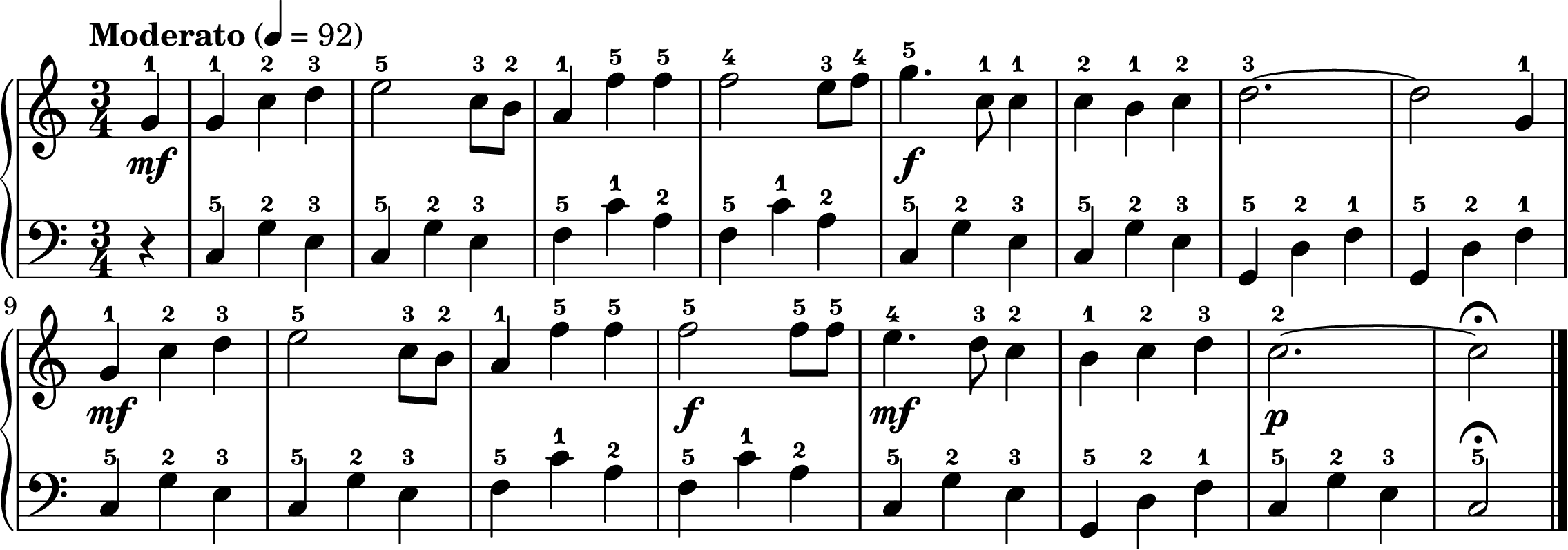
In the full score, keep the left hand turning at 66 BPM while the melody leaps, land the pinky on F5 exactly with the F3 bass note in measure 3, and work toward 92 BPM with an easy swing, like riding at a walk rather than a gallop.
Note by note: keys and fingering
- Right hand: The tune keeps leaping out of one hand position: it strolls up from the thumb (1) on G4 to C5 and D5 with 2-3, buffalo jumps a sixth from the thumb on A4 to the pinky (5) on F5, and deer starts high on G5 with the pinky before dropping to the thumb on C5. Anchor the thumb around C5 and let the hand open for the leaps.
- Left hand: A true waltz bass, one chord per bar in broken form, pinky (5) on the bass note and thumb (1) on the top: C is C3-G3-E3 (5-2-3), F is F3-C4-A3 (5-1-2), G7 is G2-D3-F3 (5-2-1).
| Note | On the Staff | On the Keyboard | Finger |
|---|---|---|---|
| G4 | Second line of treble staff | Between first two of three black keys | RH Thumb (1) |
| A4 | Second space of treble staff | Between last two of three black keys | RH Thumb (1) |
| B4 | Middle line of treble staff | Right of three black keys | RH Index (2) |
| C5 | Third space of treble staff | One octave above middle C | RH Index (2) |
| D5 | Fourth line of treble staff | Right of C5 | RH Middle (3) |
| E5 | Fourth space of treble staff | Right of D5 | RH Pinky (5) |
| F5 | Top line of treble staff | Left of three black keys, above E5 | RH Pinky (5) |
| G5 | Space above the top line | One octave above G4 | RH Pinky (5) |
| G2 | Bottom line of bass staff | Second G below middle C | LH Pinky (5) |
| C3 | Second space of bass staff | One octave below middle C | LH Pinky (5) |
| D3 | Third line of bass staff | Between the two black keys below middle C | LH Index (2) |
| E3 | Third space of bass staff | Right of two black keys | LH Middle (3) |
| F3 | Fourth line of bass staff | Left of three black keys | LH Pinky (5) |
| G3 | Fourth space of bass staff | Between first two black keys | LH Index (2) |
| A3 | Top line of bass staff | Between last two of three black keys, below middle C | LH Index (2) |
| C4 | Ledger line above bass staff | Middle C | LH Thumb (1) |
Prefer a video? Watch the keys light up
Same color code as the player: green marks the right hand, blue the left hand, with the score and keyboard in one vertical video.
The story behind Home on the Range
In 1873, Dr. Brewster Higley wrote a poem about his cabin on the Kansas prairie, and his neighbor Daniel Kelley set it to a lilting waltz. Cowboys carried Home on the Range up every cattle trail until nobody remembered who wrote it, and it became the unofficial anthem of the American prairie. It was reportedly Franklin Roosevelt's favorite song, and in 1947 Kansas made it the official state song. The verse in this arrangement is the one everyone knows, Oh, give me a home where the buffalo roam, waltzing in 3/4 with a leaping, open-air melody over a broken-chord bass, pure Thanksgiving Americana.
Get the printable PDF
The printable PDF of Home on the Range - full score, hand positions, and a step-by-step practice guide - ships inside our free Thanksgiving pack together with fourteen other Thanksgiving pieces.
An open-air waltz like this sounds best when you can sway freely from a well-set seat, and an Adjustable Piano Bench with Back Support makes that height easy to fix for every player in the family.
Piano teacher? Track your students' practice. Join the early list
FAQ
How hard is Home on the Range on piano?
It is a Level 3 piece in our Thanksgiving collection. The right hand ranges from G4 to G5 and keeps leaping out of one position, a sixth from A4 up to F5 and down from G5 to C5, while the left hand plays a broken-chord waltz bass with C, F and G7 shapes.
How long does it take to learn Home on the Range?
Two to three weeks. Measures 9-11 are fingered exactly like measures 1-3, so the second half comes by transfer; the two leaps and the tied notes across bar lines are what need slow, eyes-closed repetition.
What level is Home on the Range?
Level 3 of our Thanksgiving collection. It introduces wide melodic leaps, a tied note held across a bar line, forte and piano contrasts, and a moving waltz bass in 3/4 with a different chord shape almost every two bars.
What are the notes for Home on the Range?
The melody starts on an upbeat G4, then G4, C5, D5, a long E5, C5, B4, then A4 leaping to F5, F5, and F5, E5, F5, up to G5 and down to C5, C5, C5, B4, C5, and a long D5. The left hand plays C3-G3-E3, F3-C4-A3 and G2-D3-F3, one chord per bar. See the full table above.