
Shenandoah is the great American river song, and this easy C major arrangement is built around the interactive player below: hear the wide, arching melody at half speed, watch the notes and keys light up, and drag the score to replay the big leap. The sheet music, fingering for both hands, and a free printable PDF come next.
Learn it with the interactive player
- Slow it down: x0.5 or x0.75 while you learn the notes, back to x1 once they flow.
- Pause anywhere: the current keys stay lit so you can find them on your own piano.
- Drag the score left or right, or use the 15s buttons, to replay a phrase.
The sheet music, section by section

Set the player to x0.5 for Section A (upbeat plus measures 1-8): the melody rises from a quiet G4 through Oh Shenandoah on repeated C5s, climbs D5-E5-F5-G5 with a crescendo, and leaps from E5 to high C6 on Away in measure 3, the peak of the whole piece. You rolling river floats back down A5-G5-E5, and the second Oh Shenandoah settles gently toward C5.
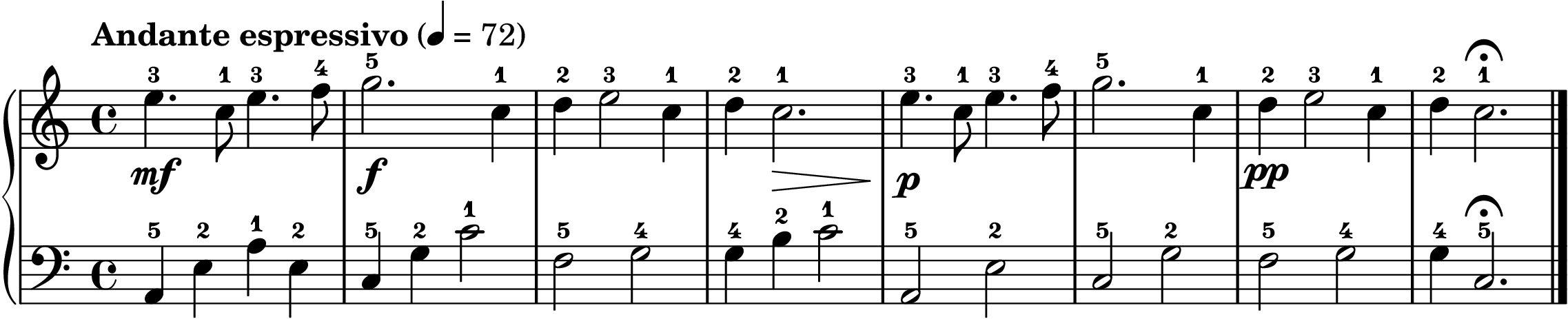
Section B (measures 9-16): Away, I'm bound away surges E5-C5-E5-F5 up to a long forte G5, then across the wide Missouri sinks D5-E5-C5 to rest on C5. Measures 13-16 repeat the same four bars as a pianissimo echo, like the song drifting downriver, over sparse half-note chords.
The full score
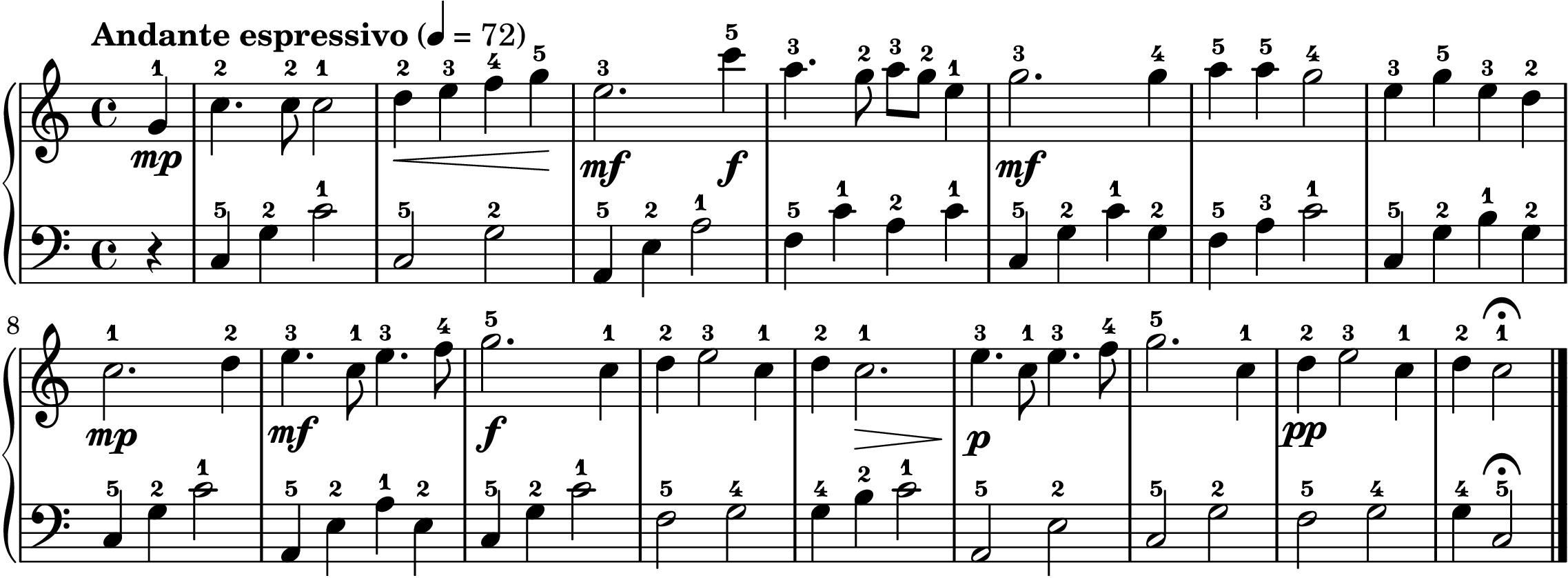
In the full score, start at 56 BPM with the left hand placing each low note exactly on beat 1, shape measure 2 with the printed crescendo so the C6 arrives as the natural peak, and aim for 72 BPM with a flexible, singing rubato and a long final fermata.
Note by note: keys and fingering
- Right hand: The hand starts with the thumb (1) on G4, settles into C position with the index (2) then the thumb on the repeated C5 and the middle finger (3) on E5, then opens up for the climb D5-E5-F5-G5 with 2-3-4-5: at the climax the pinky (5) leaps from E5 to high C6. Plan each position shift during the long notes.
- Left hand: Broken chords, one harmony per measure, pinky (5) always on the lowest note and thumb (1) on the highest: C (C3-G3-C4 with 5-2-1), A minor (A2-E3-A3), F (F3-C4-A3) and G (G3-B3-C4 at the cadence). The echo in measures 13-16 thins to half notes.
| Note | On the Staff | On the Keyboard | Finger |
|---|---|---|---|
| G4 | Second line of treble staff | Between first two of three black keys | RH Thumb (1) |
| C5 | Third space of treble staff | One octave above middle C | RH Index (2) |
| D5 | Fourth line of treble staff | Right of C5, between two black keys | RH Index (2) |
| E5 | Fourth space of treble staff | Two white keys above C5 | RH Middle (3) |
| F5 | Top line of treble staff | Left of the three black keys above C5 | RH Ring (4) |
| G5 | Space above the top line | One octave above G4 | RH Pinky (5) |
| A5 | First ledger line above staff | One octave above A4 | RH Middle (3) |
| C6 | Second ledger line above staff | Two octaves above middle C | RH Pinky (5) |
| A2 | Bottom space of bass staff | Two octaves below middle C | LH Pinky (5) |
| C3 | Second space of bass staff | One octave below middle C | LH Pinky (5) |
| E3 | Third space of bass staff | Right of two black keys, below middle C | LH Index (2) |
| F3 | Fourth line of bass staff | Left of three black keys | LH Pinky (5) |
| G3 | Fourth space of bass staff | Between first two black keys | LH Index (2) |
| A3 | Top line of bass staff | Between last two of three black keys, below middle C | LH Thumb (1) |
| B3 | Ledger area just above bass staff | White key left of middle C | LH Thumb (1) |
| C4 | Ledger line above bass staff | Middle C | LH Thumb (1) |
Prefer a video? Watch the keys light up
Same color code as the player: green marks the right hand, blue the left hand, with the score and keyboard in one vertical video.
The story behind Shenandoah
Shenandoah began on the water. In the early 1800s, fur traders rowing the wide Missouri sang it as they worked, a lament for a home and a love left far behind. River boatmen carried it to the sea, and deep-water sailors turned it into a capstan shanty, hauling up anchors to its long, rolling phrases in every port from New York to Liverpool. That is how an American river song crossed the ocean and came back a classic. Today it is sung at Thanksgiving concerts as a song of homecoming, and its wide, arching melody, with the leap to high C at the climax, is one of the most beautiful things a young pianist can learn to shape.
Get the printable PDF
The printable PDF of Shenandoah - full score, hand positions, and a step-by-step practice guide - ships inside our free Thanksgiving pack together with fourteen other Thanksgiving pieces.
A melody that leaps a sixth to high C asks for a free, open arm, and an Adjustable Piano Bench with Back Support set so your elbows sit just above the keys gives it room to move.
Piano teacher? Track your students' practice. Join the early list
FAQ
How hard is Shenandoah on piano?
It is a Level 3 piece in our Thanksgiving collection, the level for expression and wide melodies. The right hand ranges from G4 up to high C6 with several position shifts, and the left hand plays single-note broken chords, one harmony per measure, thinning to half notes in the echo.
How long does it take to learn Shenandoah?
Three to four weeks. The notes are not many, but the leap from E5 to C6 in measure 3, the position shifts planned during long notes, and the dynamic shaping from forte to pianissimo all take patient, musical practice.
What level is Shenandoah?
Level 3 of our Thanksgiving collection. It introduces a leap of a sixth to C6, a crescendo written into the score, an echo repeat played pianissimo, and rubato, with the right hand moving between the thumb on G4, C position and the open climb to G5.
What are the notes for Shenandoah?
The melody starts on an upbeat G4, then C5, C5, C5, climbs D5, E5, F5, G5, holds E5 and leaps to C6, then falls A5, G5, A5, G5, E5 and rests on G5. The second phrase goes G5, A5, A5, G5, E5, G5, E5, D5, C5. The left hand rolls C3-G3-C4, A2-E3-A3 and F3-C4-A3-C4. See the full table above.