
Bringing in the Sheaves is the bounciest harvest song in America, and this easy C major arrangement is built around the interactive player below: hear the dotted rhythm at half speed, watch the notes and keys light up, and drag the score to replay any bar. The sheet music, fingering for both hands, and a free printable PDF come next.
Learn it with the interactive player
- Slow it down: x0.5 or x0.75 while you learn the notes, back to x1 once they flow.
- Pause anywhere: the current keys stay lit so you can find them on your own piano.
- Drag the score left or right, or use the 15s buttons, to replay a phrase.
The sheet music, section by section
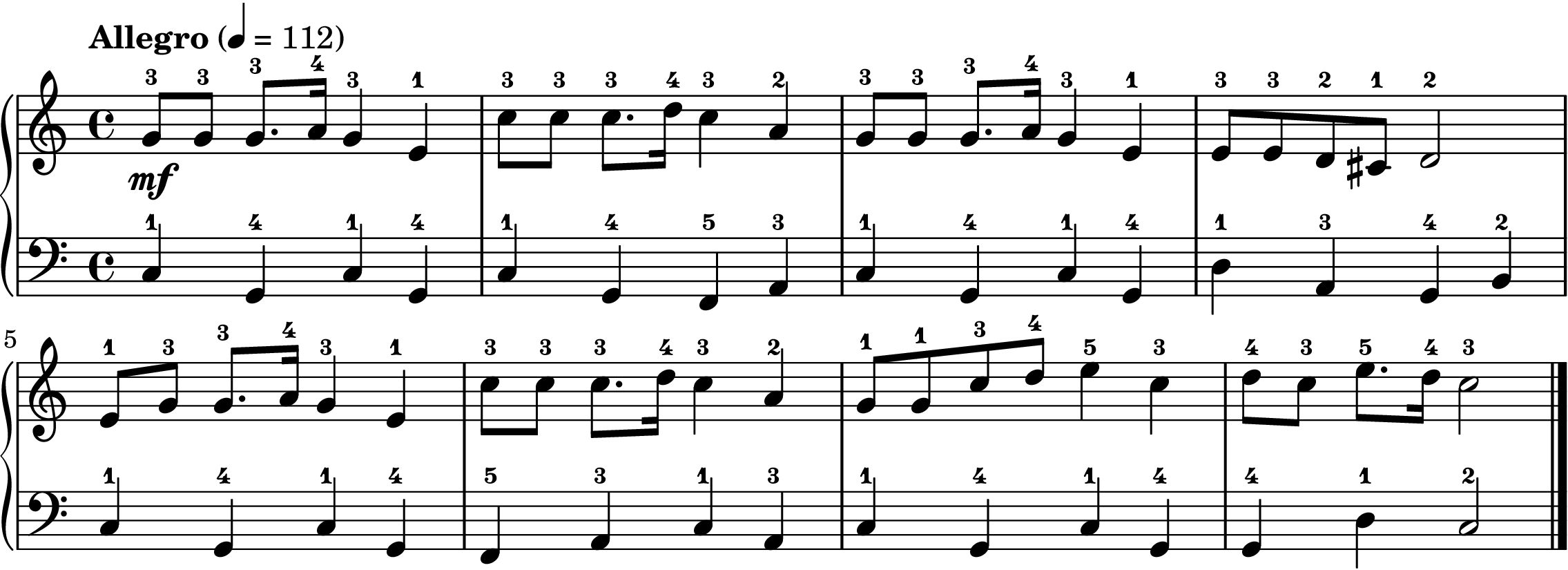
Take Section A (measures 1-8), the verse, at x0.5: sowing in the morning rocks between a low G4-E4 figure and a high C5 answer, with a snappy dotted eighth-sixteenth on in the. Measure 4 springs its one surprise, a C sharp under the thumb on dewy, and the verse ends with the first full chorus line climbing G4-C5-D5-E5.
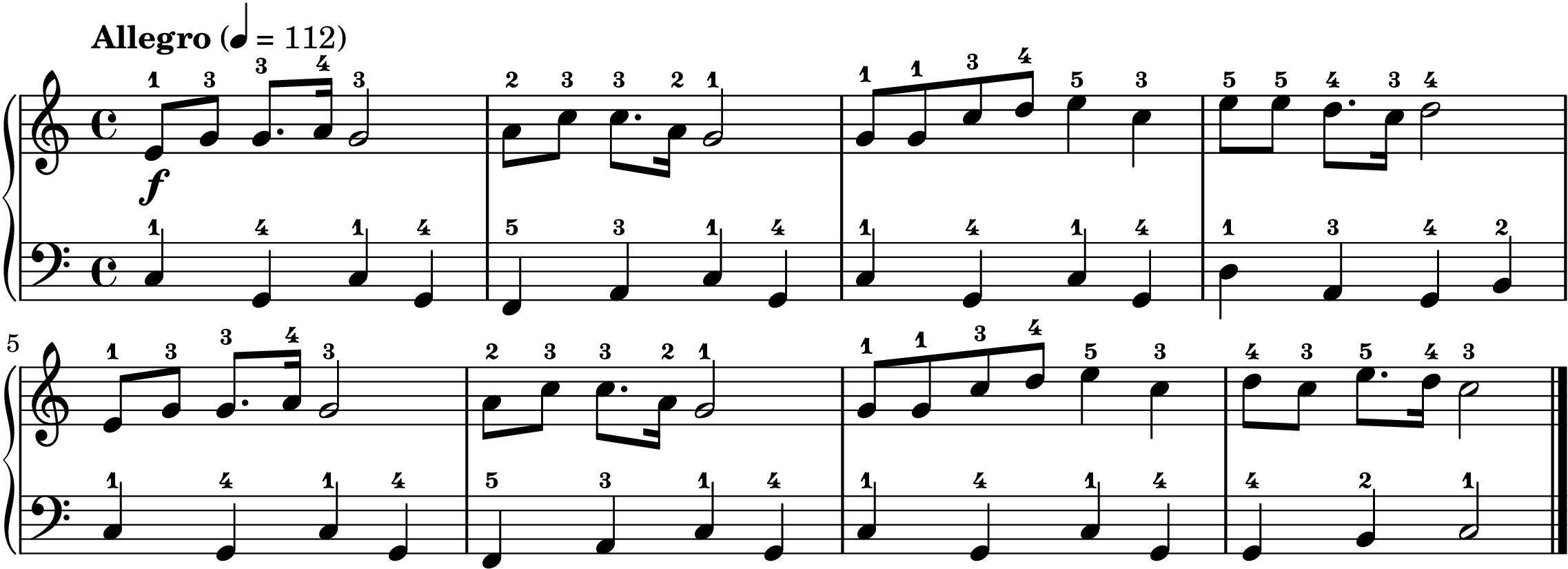
Section B (measures 9-16) is the chorus everyone knows: two answering phrases arc up from E4 and A4, the hand opens into the stretched frame for we shall come rejoicing and rings out E5 at the top, and the last line lands home on a half-note C5 while the bass walks G2-B2-C3.
The full score
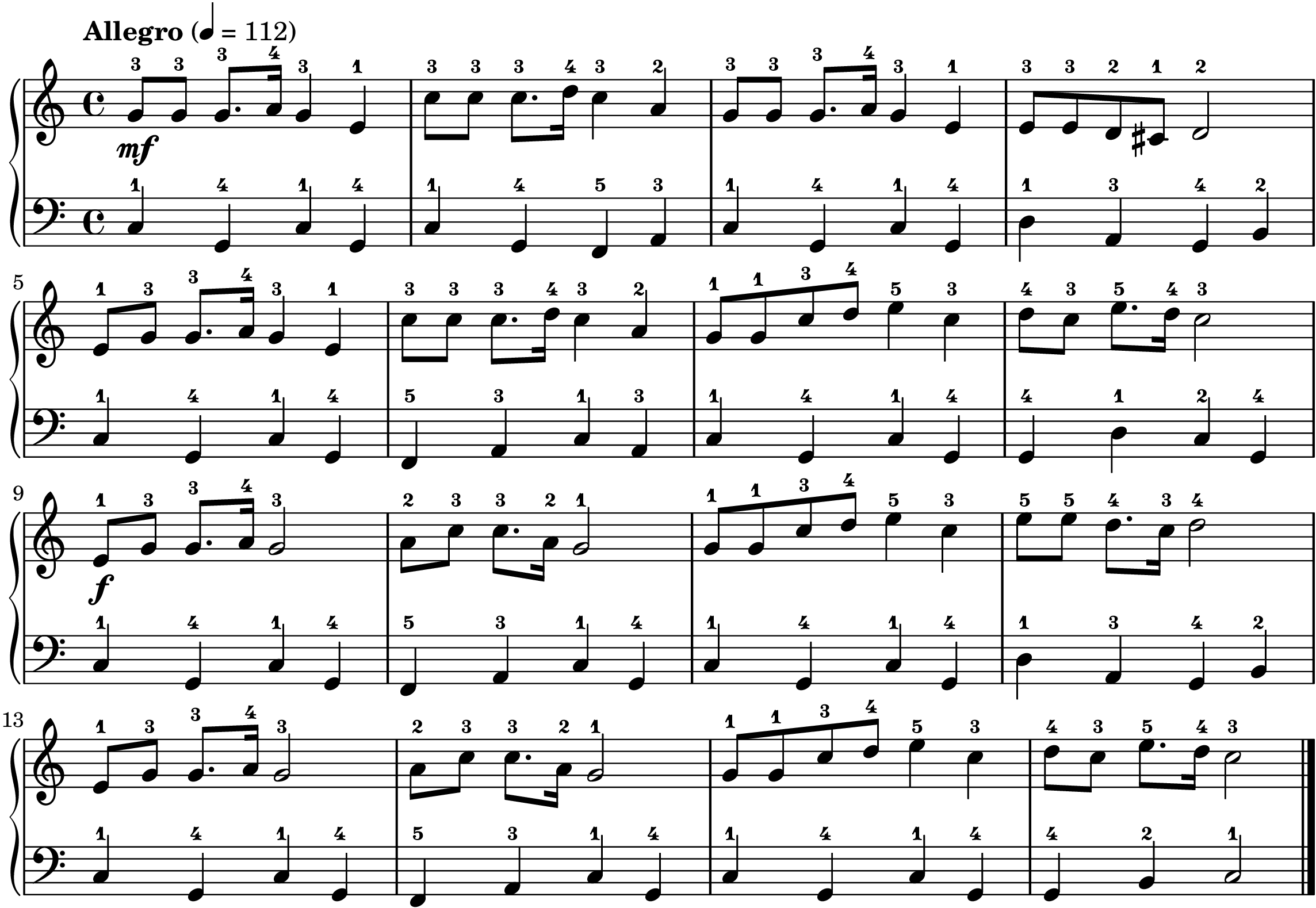
In the full score, clap the long-short dotted figure first, then play hands together at 80 BPM with the left hand bouncing straight quarters like a drummer; the target is 112 BPM with a light, happy bounce, verse mezzo forte and chorus forte.
Note by note: keys and fingering
- Right hand: Two hand frames: a low frame with the thumb (1) on E4 and the middle finger (3) on G4 for the sowing phrases, and a stretched high frame for the chorus with the thumb on G4 and fingers 3-4-5 spread over C5, D5 and E5. One surprise black key, C sharp 4, appears under the thumb in measure 4.
- Left hand: One extended position for the whole song: pinky (5) over F2, ring finger (4) on G2, thumb (1) over C3 and D3. The bass bounces root-fifth like a country band, C3 to G2, drops to F2 for the F chords, and walks G2-B2-C3 with 4-2-1 at the final cadence.
| Note | On the Staff | On the Keyboard | Finger |
|---|---|---|---|
| C#4 | Ledger line below staff, sharp sign | Black key right of middle C | RH Thumb (1) |
| D4 | Just below the bottom line | Right of middle C, between two black keys | RH Index (2) |
| E4 | Bottom line of treble staff | Right of the two black keys near middle C | RH Thumb (1) |
| G4 | Second line of treble staff | Between first two of three black keys | RH Middle (3) |
| A4 | Second space of treble staff | Between last two of three black keys | RH Ring (4) |
| C5 | Third space of treble staff | One octave above middle C | RH Middle (3) |
| D5 | Fourth line of treble staff | Right of C5, between two black keys | RH Ring (4) |
| E5 | Fourth space of treble staff | Right of D5 | RH Pinky (5) |
| F2 | Below the bottom line of bass staff | Two octaves below middle C, left of three black keys | LH Pinky (5) |
| G2 | Bottom line of bass staff | Two octaves below middle C, between first two of three black keys | LH Ring (4) |
| A2 | Bottom space of bass staff | Two octaves below middle C, after three black keys | LH Middle (3) |
| B2 | Second line of bass staff | Right of three black keys, below C3 | LH Index (2) |
| C3 | Second space of bass staff | One octave below middle C | LH Thumb (1) |
| D3 | Third line of bass staff | Between the two black keys below middle C | LH Thumb (1) |
Prefer a video? Watch the keys light up
Same color code as the player: green marks the right hand, blue the left hand, with the score and keyboard in one vertical video.
The story behind Bringing in the Sheaves
Knowles Shaw, a singing evangelist from Ohio, wrote these words in 1874 after reading Psalm 126, which promises that whoever goes out weeping with seed will come back rejoicing, bringing the sheaves. A sheaf is a bundle of harvested wheat, so this is literally a song about bringing in the harvest. George A. Minor, a Sunday school music director from Richmond, gave it its irresistibly bouncy tune in 1880, and it became one of the best-loved harvest and revival songs in America, whistled in westerns and sung at Thanksgiving ever since. The crisp dotted rhythm gives the piece its cheerful, slightly proud character, and this arrangement keeps it over a root-fifth country bass.
Get the printable PDF
The printable PDF of Bringing in the Sheaves - full score, hand positions, and a step-by-step practice guide - ships inside our free Thanksgiving pack together with fourteen other Thanksgiving pieces.
A bouncing left hand stays relaxed only when your elbows hang naturally at the keys, and an Adjustable Piano Bench with Back Support set to the right height makes that the default.
Piano teacher? Track your students' practice. Join the early list
FAQ
How hard is Bringing in the Sheaves on piano?
It is a Level 2 piece in our Thanksgiving collection. The right hand uses two hand frames between C sharp 4 and E5, with a dotted eighth-sixteenth rhythm throughout and one black key in measure 4, and the left hand bounces root-fifth quarter notes in a single position from F2 to D3.
How long does it take to learn Bringing in the Sheaves?
About two weeks. The verse and chorus share most of their material, with measure 12 the only really new line, but the dotted rhythm at 112 BPM and the steady bouncing bass need patient hands-together work starting around 80 BPM.
What level is Bringing in the Sheaves?
Level 2 of our Thanksgiving collection. It introduces the dotted gospel rhythm, a moving single-note bass that bounces root and fifth every beat, one black key under the thumb, and a stretch of the pinky to E5 in the chorus.
What are the notes for Bringing in the Sheaves?
The verse starts G4, G4, G4, A4, G4, E4, then C5, C5, C5, D5, C5, A4, repeats the first bar, and dips E4, E4, D4, C sharp 4, D4. The chorus begins E4, G4, G4, A4, G4, then A4, C5, C5, A4, G4, and climbs G4, G4, C5, D5, E5, C5. The left hand alternates C3 and G2 with F2 for the F chords. See the full table above.