
All Things Bright and Beautiful is an old English dance tune turned children’s hymn, and the interactive player below is the easiest way to learn it: hear it at half speed, watch the keys light up, and drag the score to replay the famous dip. The sheet music, fingering for both hands, and a free printable PDF come next.
Learn it with the interactive player
- Slow it down: x0.5 or x0.75 while you learn the notes, back to x1 once they flow.
- Pause anywhere: the current keys stay lit so you can find them on your own piano.
- Drag the score left or right, or use the 15s buttons, to replay a phrase.
The sheet music, section by section

Take Section A (measures 1-8), the refrain, at x0.5: G5 opens with the pinky and rocks down to E5, a sparkling eighth-note run D5-C5-B4-A4 falls onto the thumb on G4, then comes the signature dip, up to E5-F5 and suddenly down to A4-B4 for great and small, closing on a whole-note C5. Measures 5-8 repeat it all.

Section B is the verse, with an upbeat G4 into measures 9-16: the thumb starts low on E4 for E-G-G-F-E, little bird that sings skips B4-C5-D5 twice and rests on a long G4, then the melody climbs from C5 through F5 to the bright G5 peak before the same dip A4-B4-C5 closes the piece.
The full score
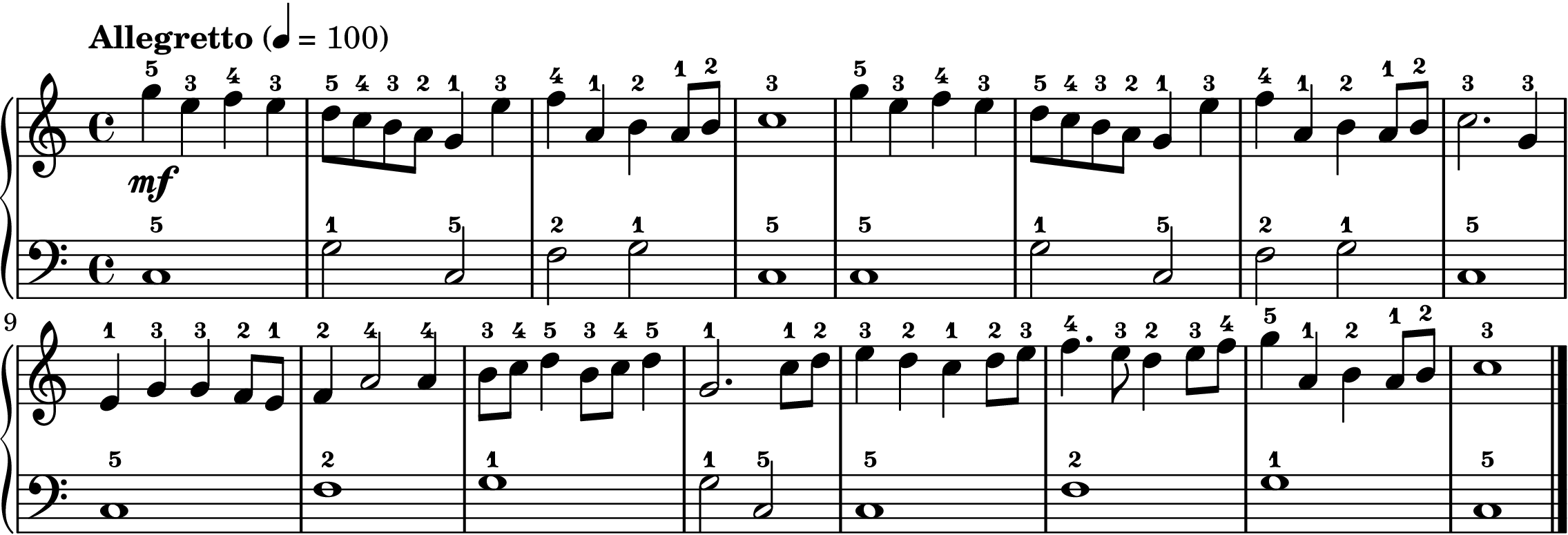
In the full score, start at 66 BPM with only the refrain, keep the eighth-note runs light and even, and let the whole thing skip along toward a bright 100 BPM with a warm, unhurried final C5.
Note by note: keys and fingering
- Right hand: One five-finger position per phrase from E4 up to G5: the refrain sits in C position (thumb (1) on C5, pinky (5) on G5), drops to G position for the falling run with the thumb landing on G4, and uses A position (thumb on A4) for the cadences; the verse starts with the thumb on E4 and climbs back through G, C and A positions.
- Left hand: Pinky (5) on C3, index (2) on F3, thumb (1) on G3: a whole note in most measures and two half notes in measures 2-3, 6-7 and 12, and the hand never moves.
| Note | On the Staff | On the Keyboard | Finger |
|---|---|---|---|
| E4 | Bottom line of treble staff | Third white key from middle C | RH Thumb (1) |
| F4 | First space of treble staff | Left of the three black keys | RH Index (2) |
| G4 | Second line of treble staff | Fifth white key from middle C | RH Thumb (1) |
| A4 | Second space of treble staff | Between last two of three black keys | RH Index (2) |
| B4 | Middle line of treble staff | Right of three black keys | RH Middle (3) |
| C5 | Third space of treble staff | One octave above middle C | RH Ring (4) |
| D5 | Fourth line of treble staff | Right of C5 | RH Pinky (5) |
| E5 | Fourth space of treble staff | Right of D5 | RH Middle (3) |
| F5 | Top line of treble staff | Left of three black keys above C5 | RH Ring (4) |
| G5 | Space above top line | Highest note of the piece | RH Pinky (5) |
| C3 | Second space of bass staff | One octave below middle C | LH Pinky (5) |
| F3 | Fourth line of bass staff | Fourth white key above C3 | LH Index (2) |
| G3 | Top space of bass staff | Fifth white key above C3 | LH Thumb (1) |
Prefer a video? Watch the keys light up
Same color code as the player: green marks the right hand, blue the left hand, with the score and keyboard in one vertical video.
The story behind All Things Bright and Beautiful
The words come from Cecil Frances Alexander's 1848 collection of hymns for children, a list of everything worth being thankful for, from each little flower that opens to each little bird that sings. The tune is far older: it began as The Twenty-Ninth of May, a 17th-century English dance printed in Playford's Dancing Master in 1686, and its name Royal Oak remembers the oak tree where King Charles II famously hid. The hymn form played here is Martin Shaw's arrangement, published in his Song Time in 1915, which reshapes the dance's cadences. William Henry Monk wrote a rival tune in 1887, but it is this old dance melody, in Shaw's version, that children around the world still sing. Its most charming trick is the sudden dip, when the tune leaps down cheerfully in the middle of a line like a bird hopping off a branch.
Get the printable PDF
The printable PDF of All Things Bright and Beautiful - full score, hand positions, and a step-by-step practice guide - ships inside our free Thanksgiving pack together with fourteen other Thanksgiving pieces.
Skipping eighth-note runs stay light when your wrists float level with the keys, and an Adjustable Piano Bench with Back Support makes that height easy to set for every player in the family.
Piano teacher? Track your students' practice. Join the early list
FAQ
How hard is All Things Bright and Beautiful on piano?
It is a Level 1 piece in our Thanksgiving collection, with a little more movement than the hymns. The right hand covers a tenth from E4 to G5 on white keys, one five-finger position per phrase, and the left hand plays whole and half notes on only C3, F3 and G3.
How long does it take to learn All Things Bright and Beautiful?
About one to two weeks. The refrain is played twice note for note, so measures 1-4 teach you half the piece, and the verse reuses the same closing dip; the eighth-note run in measure 2 and the leap from F5 down to A4 are the two spots that need slow repetition.
What level is All Things Bright and Beautiful?
Level 1 of our Thanksgiving collection. It uses five-finger positions with the thumb on C5, G4, A4 or E4, no black keys, a few eighth-note runs and one upbeat before the verse, over a three-note bass.
What are the notes for All Things Bright and Beautiful?
The refrain starts G5, E5, F5, E5, then the run D5, C5, B4, A4 down to G4, up to E5, F5, and the dip A4, B4, A4, B4 onto a long C5. The verse begins on an upbeat G4 and continues E4, G4, G4, F4, E4, F4, A4. The left hand holds C3, F3 or G3 under each bar. See the full table above.