
The Prelude in C major opens Bach’s Well-Tempered Clavier, and the interactive player below suits it perfectly: run the broken chords at half speed, watch each note and key light up in turn, and drag the score to any measure. The sheet music, fingering, and a free printable PDF are just below.
Learn it with the interactive player
- Slow it down: x0.5 or x0.75 while you learn the notes, back to x1 once they flow.
- Pause anywhere: the current keys stay lit so you can find them on your own piano.
- Drag the score left or right, or use the 15s buttons, to replay a phrase.
The sheet music, section by section

Set the player to x0.5 and study the very first measure: after an eighth rest, the right hand rolls E4-G4-C5-E5 twice, thumb on E4 exactly as the score marks. Every measure of Section A is that same gesture on a new chord.

Section B colors the pattern with new harmonies - watch for the measures with F#4 - before the music finds its way home. The left hand still just holds two half notes per measure.
The full score
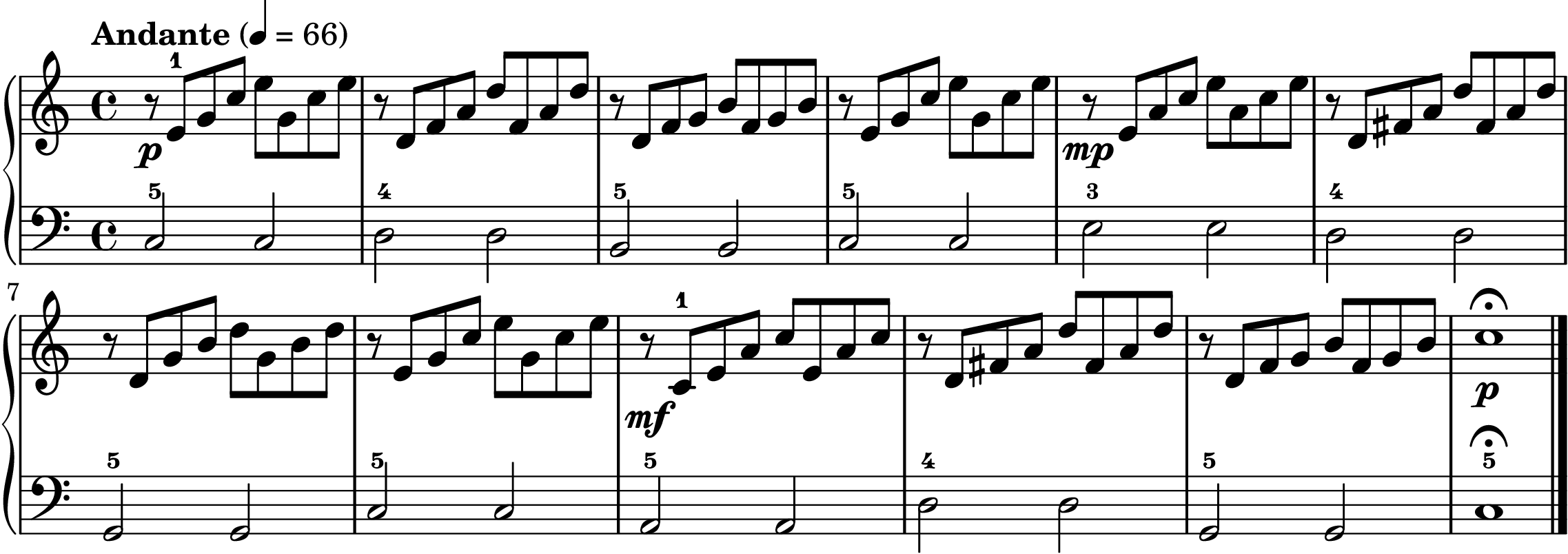
In the full score, keep the eighth notes perfectly even at a calm 66 BPM and let the harmonies drift, one per measure, all the way to the final held C.
Note by note: keys and fingering
- Right hand: Broken chords rolling from middle C up to E5 - the thumb (1) takes the lowest note of every figure, as the score marks on E4 and C4, fingers 2 and 3 cover the middle notes, and the ring finger or pinky reaches the top of each arpeggio.
- Left hand: C3, D3, E3, B2, A2, G2 - two held half notes per measure. The score marks the pinky (5) on C3, B2, A2, and G2, the ring finger (4) on D3, and the middle finger (3) on E3.
| Note | On the Staff | On the Keyboard | Finger |
|---|---|---|---|
| E5 | Fourth space of treble staff | White key right of the two black keys above C5 | RH Pinky (5) |
| D5 | Fourth line of treble staff | White key between the two black keys above C5 | RH Pinky (5) |
| C5 | Third space of treble staff | White key left of the two black keys, one octave above middle C | RH Ring (4) |
| B4 | Third line of treble staff | White key right of the three black keys | RH Pinky (5) |
| A4 | Second space of treble staff | White key between the last two of three black keys | RH Middle (3) |
| G4 | Second line of treble staff | White key between the first two of three black keys | RH Index (2) |
| F#4 | First space of treble staff, with a sharp sign | Black key right of F4 | RH Index (2) |
| F4 | First space of treble staff | White key left of the three black keys | RH Index (2) |
| E4 | Bottom line of treble staff | White key right of the two black keys above middle C | RH Thumb (1) |
| D4 | Just below the bottom line of treble staff | White key between the two black keys above middle C | RH Thumb (1) |
| C4 (Middle C) | One ledger line below treble staff | White key left of the two black keys, center of the keyboard | RH Thumb (1) |
| E3 | Third space of bass staff | White key right of the two black keys below middle C | LH Middle (3) |
| D3 | Middle line of bass staff | White key between the two black keys below middle C | LH Ring (4) |
| C3 | Second space of bass staff | White key one octave below middle C | LH Pinky (5) |
| B2 | Second line of bass staff | White key right of the three black keys, two octaves down | LH Pinky (5) |
| A2 | First space of bass staff | White key between the last two of three black keys, two octaves down | LH Pinky (5) |
| G2 | First line of bass staff | White key between the first two of three black keys, two octaves down | LH Pinky (5) |
Prefer a video? Watch the keys light up
Same color code as the player: green marks the right hand, blue the left hand, with the score and keyboard in one vertical video.
The story behind the Prelude in C
Bach placed this prelude at the head of The Well-Tempered Clavier, Book I, completed in 1722: a cycle of preludes and fugues in all 24 major and minor keys, written to show that a well-tuned keyboard could play in every one of them. The prelude has no melody in the usual sense - it is a single broken-chord pattern, one harmony per measure, drifting through Bach's harmonic world. An earlier version appears in the 1720 notebook Bach compiled for his son Wilhelm Friedemann. In 1853 Charles Gounod floated his Ave Maria melody over the top of it, proof of how complete the harmony already is on its own.
Get the printable PDF
The printable PDF of this easy Prelude in C - full score, hand positions, and a step-by-step practice guide - ships inside our free Level 5 pack with four other advanced beginner favorites.
Even, unhurried arpeggios come easiest from a well-set seat, and an Adjustable Piano Bench with Back Support adjusts to put your hands at exactly the right angle to the keys.
FAQ
How hard is the Prelude in C on piano?
There is no melody to memorize and no rhythm trickier than even eighth notes, so many students find it the friendliest piece in our Level 5 pack. The work is in smoothness: rolling each broken chord evenly, changing hand shapes cleanly, and letting the two half-note bass tones sing underneath.
How long does it take to learn the Prelude in C?
The pattern itself takes minutes; the piece takes about two to three weeks. Most of that time goes into changing chord shapes without a bump - practice each measure as a solid chord first, then break it into the rolling eighth-note pattern at a calm 66 BPM.
What level is the Prelude in C?
This simplified excerpt belongs to the Level 5 pack, the advanced beginner tier of our free collection. Complete editions of the original prelude are usually graded around 3 to 4 on exam scales - the same idea, but sustained across some 35 measures of shifting harmony.
What are the notes for the Prelude in C?
Each measure rolls one chord: E4-G4-C5-E5 for C major, then D4-F4-A4-D5, D4-F4-G4-B4, and so on, with the thumb always on the lowest note. The left hand holds two half notes per measure on C3, D3, E3, B2, A2, or G2. The complete table with staff positions is above.