
Canon in D is Pachelbel’s timeless progression, arranged here for easy piano, and the interactive player below is the ideal way in: hear it at half speed, watch the notes and keys light up as the theme unfolds, and drag the score anywhere. Sheet music, fingering, and a free printable PDF follow.
Learn it with the interactive player
- Slow it down: x0.5 or x0.75 while you learn the notes, back to x1 once they flow.
- Pause anywhere: the current keys stay lit so you can find them on your own piano.
- Drag the score left or right, or use the 15s buttons, to replay a phrase.
The sheet music, section by section

Learn the left hand first - the eight half notes D3, A2, B2, F#2, G2, D3, G2, A2 repeat unchanged all the way through. Then set the player to x0.5 and lay the Section A melody, the famous F#-E-D-C# descent, on top.

Section B lifts the same theme an octave higher, starting from D5 under the pinky, while the ground bass keeps looping below. Nothing new happens in the left hand - that is the whole secret of a canon over a ground.
The full score
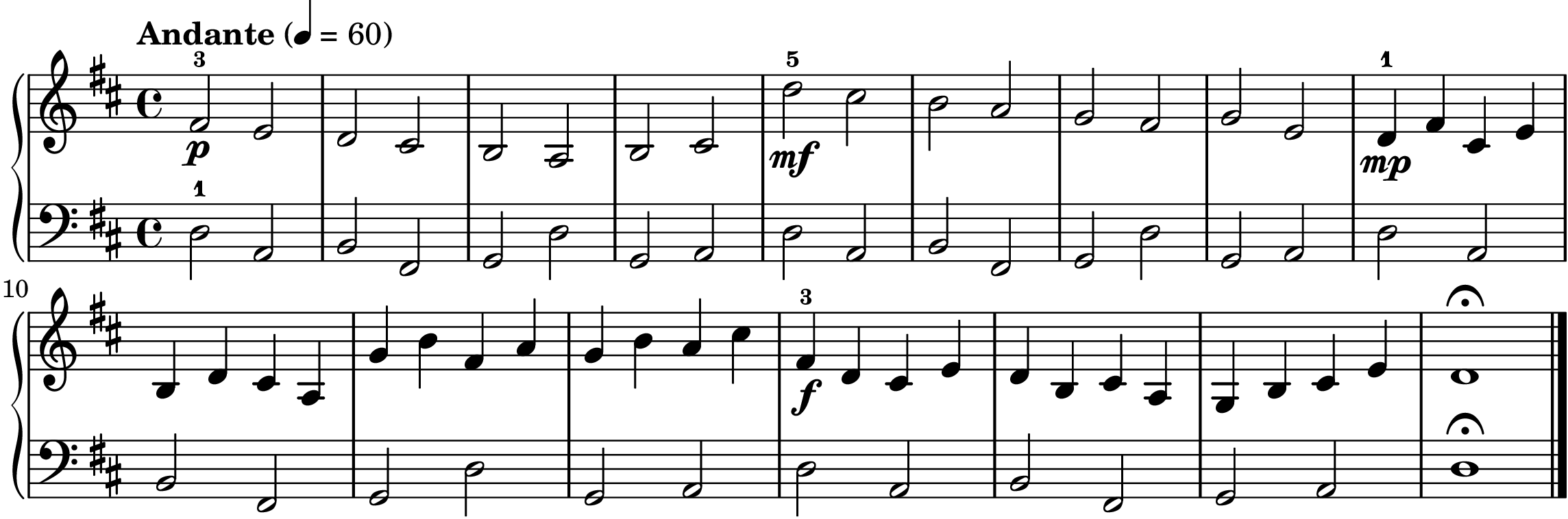
The full score ends with flowing quarter-note variations over the same eight bass notes; keep a calm Andante pulse and let the loop carry you to the final held D.
Note by note: keys and fingering
- Right hand: The famous descending theme F#4-E4-D4-C#4 down to B3 and A3, then the same line an octave higher from D5 under the pinky (5). The score marks finger 3 on the opening F#4 and the thumb (1) on D4; flowing quarter-note variations close the piece.
- Left hand: D3, A2, B2, F#2, G2 - the eight-note ground bass in half notes, looping unchanged from first measure to last. Thumb on D3, middle finger on B2, ring on A2, pinky on G2 stretching down to F#2.
| Note | On the Staff | On the Keyboard | Finger |
|---|---|---|---|
| D5 | Fourth line of treble staff | White key between the two black keys above C5 | RH Pinky (5) |
| C#5 | Third space of treble staff, with a sharp sign | Black key right of C5 | RH Ring (4) |
| B4 | Third line of treble staff | White key right of the three black keys | RH Middle (3) |
| A4 | Second space of treble staff | White key between the last two of three black keys | RH Index (2) |
| G4 | Second line of treble staff | White key between the first two of three black keys | RH Thumb (1) |
| F#4 | First space of treble staff, with a sharp sign | Black key right of F4 | RH Middle (3) |
| E4 | Bottom line of treble staff | White key right of the two black keys above middle C | RH Index (2) |
| D4 | Just below the bottom line of treble staff | White key between the two black keys above middle C | RH Thumb (1) |
| C#4 | One ledger line below treble staff, with a sharp sign | Black key right of middle C | RH Middle (3) |
| B3 | Just below the middle C ledger line | White key left of middle C | RH Index (2) |
| A3 | Second ledger line below treble staff | White key between the last two of three black keys, just below middle C | RH Thumb (1) |
| D3 | Middle line of bass staff | White key between the two black keys below middle C | LH Thumb (1) |
| B2 | Second line of bass staff | White key right of the three black keys, two octaves down | LH Middle (3) |
| A2 | First space of bass staff | White key between the last two of three black keys, two octaves down | LH Ring (4) |
| G2 | First line of bass staff | White key between the first two of three black keys, two octaves down | LH Pinky (5) |
| F#2 | Just below the first line of bass staff, with a sharp sign | Black key right of F2, at the bottom of the pattern | LH Pinky (5) |
Prefer a video? Watch the keys light up
Same color code as the player: green marks the right hand, blue the left hand, with the score and keyboard in one vertical video.
The story behind Canon in D
Johann Pachelbel wrote his Canon in D sometime around the 1680s, scoring it for three violins and basso continuo and pairing it with a gigue. Nothing certain is known about the occasion; one theory connects it to a Bach family wedding, but no evidence survives. The piece then slept for roughly two centuries until a scholarly edition appeared in 1919, and a 1968 recording by Jean-Francois Paillard's chamber orchestra turned it into a worldwide favorite and a wedding standard. Its engine is a ground bass: eight notes repeated unchanged from first measure to last while the upper voices weave ever richer variations. This easy piano arrangement keeps exactly that design.
Get the printable PDF
The printable PDF of this easy Canon in D - full score, hand positions, and a step-by-step practice guide - ships inside our free Level 5 pack together with four other advanced beginner favorites.
A piece built on endless repeats invites long sittings, and an Adjustable Piano Bench with Back Support keeps you comfortable through every pass of the ground bass.
FAQ
How hard is Canon in D on piano?
Easier than its reputation: the left hand plays the same eight half notes - D3, A2, B2, F sharp 2, G2, D3, G2, A2 - on a loop, so only the right hand really changes. In our free collection it sits in the Level 5 pack, mainly for the two sharps of D major and the octave shift in the theme.
How long does it take to learn Canon in D?
Because the bass never changes, progress is fast: the left hand is secure within a day or two, the half-note theme within a week, and the closing quarter-note variations after another week or two of practice at a calm 60 BPM pulse.
What level is Canon in D?
Simplified piano versions like this one are usually placed around grade 2 to 3 on exam scales. This arrangement belongs to the Level 5 pack of our free collection: D major with F sharp and C sharp, a repeating ground bass, and a melody that travels across two octaves.
What are the notes for Canon in D?
The theme descends F sharp 4, E4, D4, C sharp 4, B3, A3, B3, C sharp 4, then repeats an octave higher from D5. The left hand loops the famous ground bass D3, A2, B2, F sharp 2, G2, D3, G2, A2 in half notes. The full note-by-note table is above.