
Clair de Lune is Debussy’s moonlit masterpiece, distilled here into an easy C major theme you can learn with the interactive player: hear it at half speed, watch the notes and keys glow as they sound, and drag the score to move around. Sheet music, fingering, and a free printable PDF follow below.
Learn it with the interactive player
- Slow it down: x0.5 or x0.75 while you learn the notes, back to x1 once they flow.
- Pause anywhere: the current keys stay lit so you can find them on your own piano.
- Drag the score left or right, or use the 15s buttons, to replay a phrase.
The sheet music, section by section
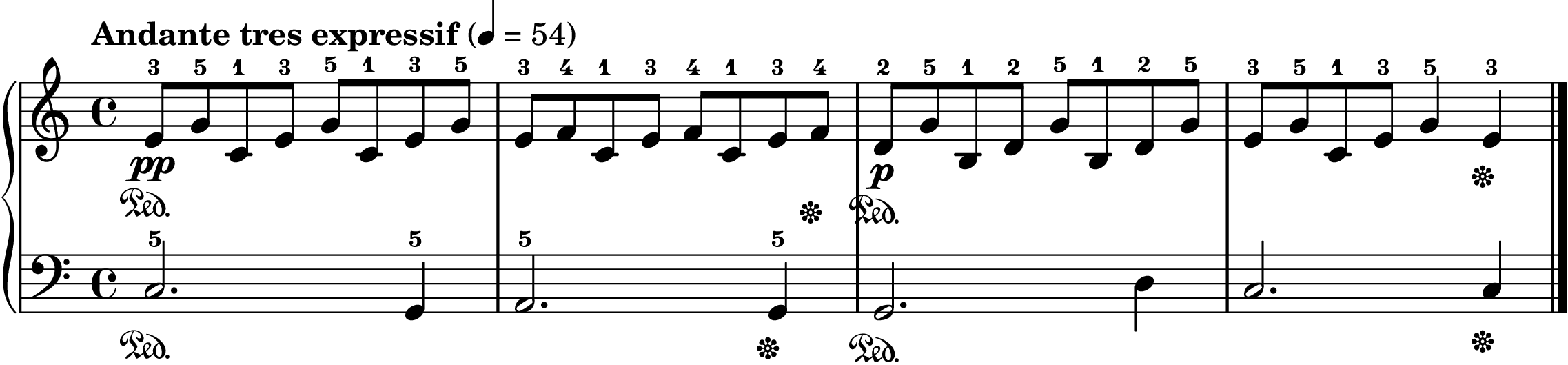
Section A floats long melody notes over harp-like broken chords - with the player at x0.5 the piece barely moves at all, which is exactly the right feeling. Press each key slowly; a fast strike makes a hard tone.
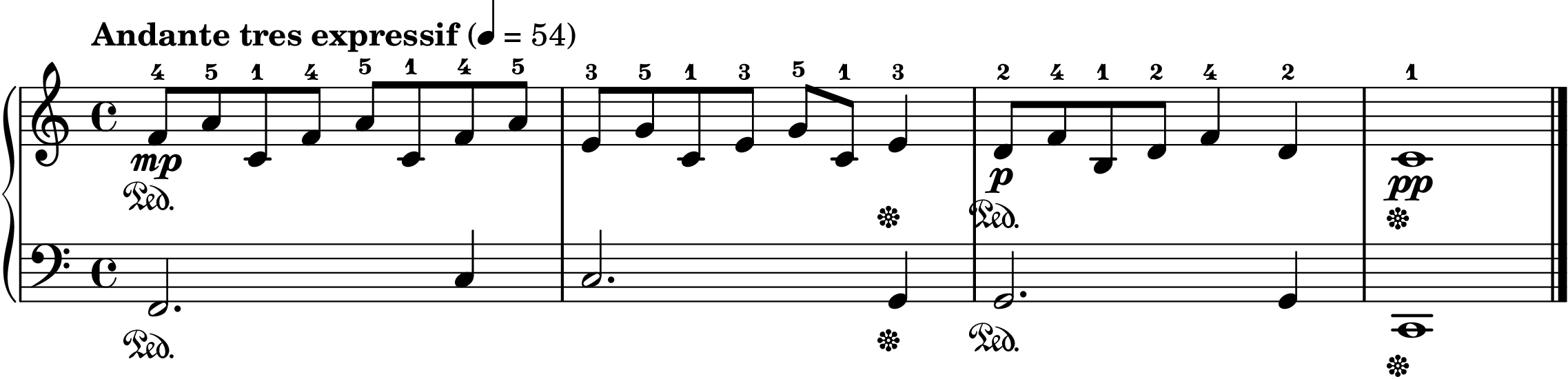
Section B lifts the line into a gentle arc before settling to the softest possible close. Let the C-E-G broken chords ripple evenly under the melody, like a harp.
The full score
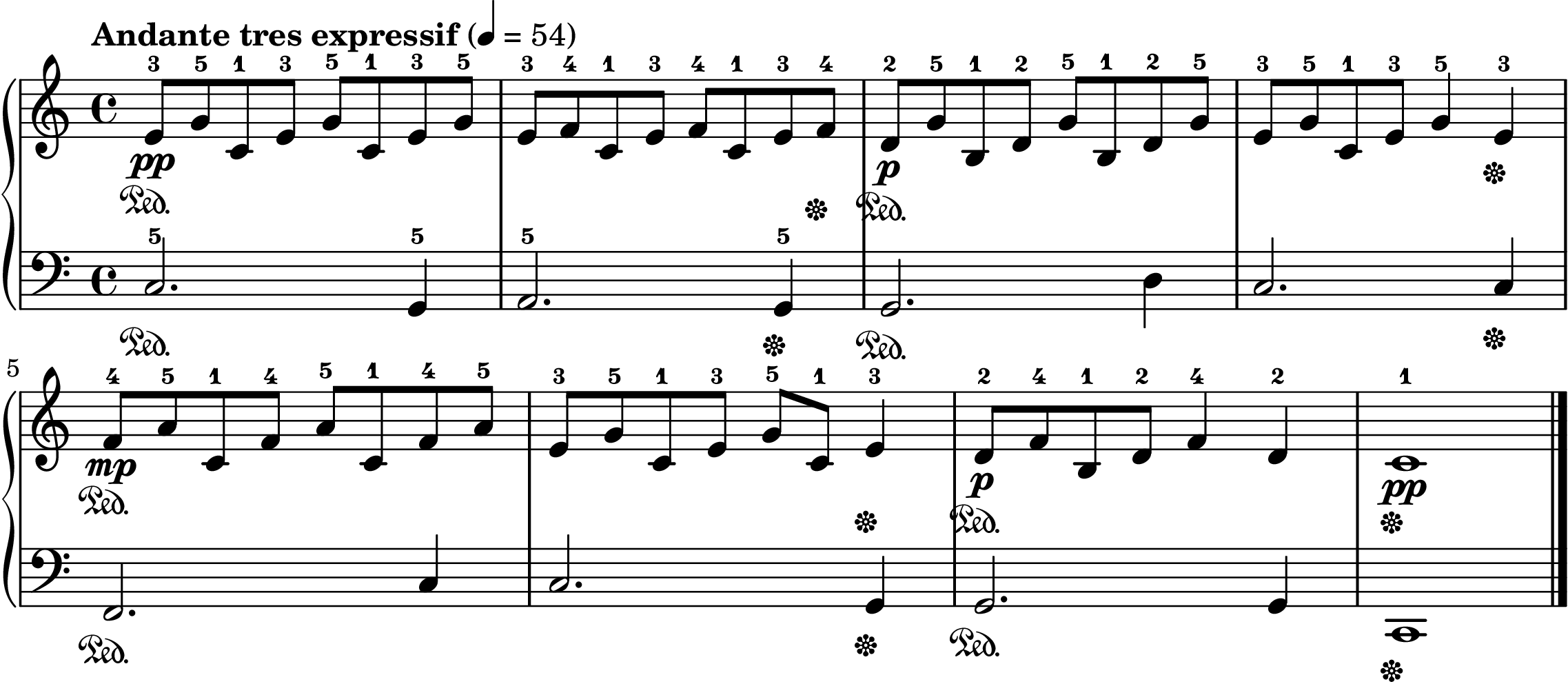
The full score should hover around 60 BPM with the sustain pedal changing on each new harmony - listen constantly and ask one question: does it sound like moonlight?
Note by note: keys and fingering
- Right hand: C4, D4, E4, F4, G4, A4 - C position with gentle extensions. Extremely legato and soft.
- Left hand: C3, E3, G3, F3, A3 - Broken chord arpeggios. Use sustain pedal throughout.
| Note | On the Staff | On the Keyboard | Finger |
|---|---|---|---|
| C4 (Middle C) | One ledger line below treble staff | White key left of two black keys, center | RH Thumb (1) |
| D4 | Just below bottom line of treble staff | Between the two black keys | RH Index (2) |
| E4 | On the bottom line of treble staff | Right of two black keys | RH Middle (3) |
| F4 | First space of treble staff | Left of three black keys | RH Ring (4) |
| G4 | Second line of treble staff | Between first two of three black keys | RH Pinky (5) |
| A4 | Second space of treble staff | Between last two of three black keys | RH stretched |
| C3 | Two ledger lines below bass staff | One octave below middle C | LH Pinky (5) |
| E3 | Fourth line of bass staff | Right of two black keys | LH Middle (3) |
| F3 | Fourth space of bass staff | Left of three black keys | LH Index (2) |
| G3 | Top line of bass staff | Between first two of three black keys | LH Thumb (1) |
| A3 | Above top line of bass staff | Between last two of three black keys | LH Thumb (1) |
Prefer a video? Watch the keys light up
Same color code as the player: green marks the right hand, blue the left hand, with the score and keyboard in one vertical video.
The story behind Clair de Lune
Debussy composed Clair de Lune around 1890 as the third movement of his Suite bergamasque, then revised it substantially before the suite was published in 1905. The title, French for moonlight, comes from a poem by Paul Verlaine in which masked dancers sing beneath a melancholy moon. Debussy matched that image with floating harmonies that blur the border between melody and atmosphere, the essence of what listeners came to call Impressionism. It became his most famous page and one of the most loved piano works ever written. This arrangement keeps the opening theme, simplified into C major, so beginners can reach its calm early.
Get the printable PDF
The printable PDF of this easy Clair de Lune theme - full score, hand positions, and a step-by-step practice guide - ships inside our free Level 5 pack with four other advanced beginner pieces.
Music this quiet exposes every tension in your body, and an Adjustable Piano Bench with Back Support helps you sit tall and relaxed while the pedal does its quiet work below.
FAQ
How hard is Clair de Lune on piano?
The original is a genuinely advanced work in D flat major with big stretches and intricate rhythms. This theme-only arrangement in C major is far gentler and sits in our Level 5 pack: easy notes, but real demands on touch, pedal, and patience at a slow 60 BPM.
How long does it take to learn Clair de Lune?
The notes of this easy theme take most advanced beginners about a week; the sound takes longer. Plan on three to four weeks to make the melody float over the broken chords with smooth pedal changes - and slow practice around 40 BPM is genuinely pleasant here.
What level is Clair de Lune?
The original Clair de Lune is usually graded around 7 on exam scales. Our simplified theme belongs to Level 5, the top tier of the free collection, where expression, pedal work, and tone control matter more than finger speed.
What are the notes for Clair de Lune?
In this arrangement the melody uses C4 to A4 - middle C position with gentle extensions - moving in long, connected tones. The left hand plays broken chords built from C3, E3, and G3, plus F3 and A3, flowing upward like a harp. The complete note table is above.