
Gymnopedie No. 1 is Satie’s floating, dreamlike waltz, and the interactive player below is made for it: listen at half speed, watch every note and key light up as it sounds, and drag the score to sit with any measure. The sheet music, fingering, and free printable PDF come right after.
Learn it with the interactive player
- Slow it down: x0.5 or x0.75 while you learn the notes, back to x1 once they flow.
- Pause anywhere: the current keys stay lit so you can find them on your own piano.
- Drag the score left or right, or use the 15s buttons, to replay a phrase.
The sheet music, section by section

Set the player to x0.5 - barely slower than the real thing - and study Section A: the left hand sets the mood alone for two measures before the long F#-E-D melody enters. Aim for a deep, warm touch on every key.
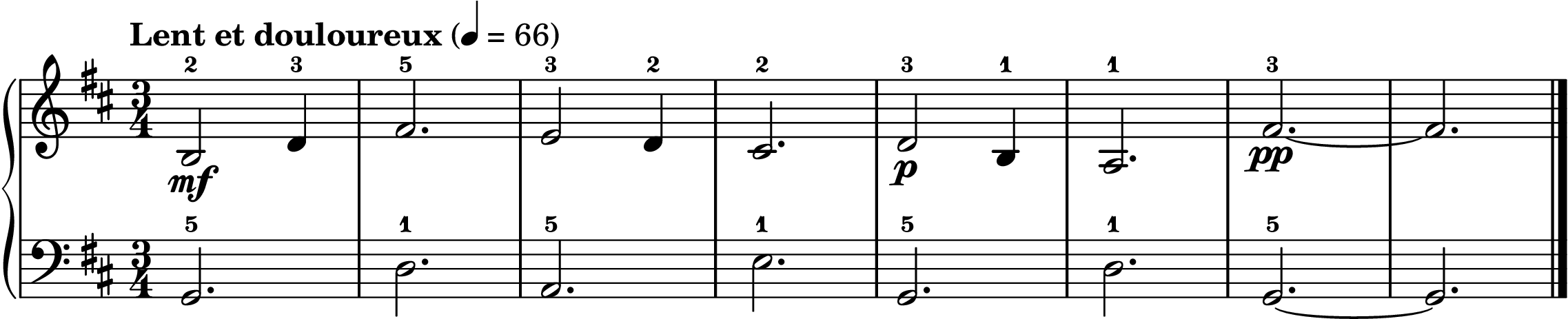
Section B rises gently through B-D-F# before settling, and the final F# simply fades away. Change the sustain pedal on beat 1 of each measure so the haze never blurs.
The full score
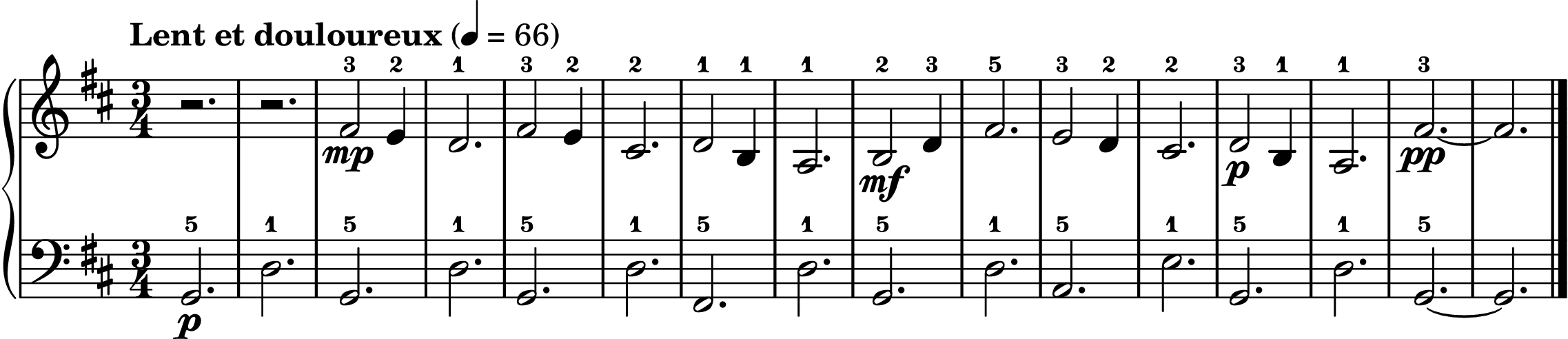
Play the full score at 72 BPM or slower - stillness is the goal here, and nothing is gained by moving on before each chord has bloomed.
Note by note: keys and fingering
- Right hand: D4, E4, F#4, G4, A4, B4 - D position. Long, sustained notes with gentle movement.
- Left hand: G2, D3, A2, E3, B2, F#3 - Alternating bass note and chord tone. Wide hand span.
| Note | On the Staff | On the Keyboard | Finger |
|---|---|---|---|
| D4 | Just below bottom line of treble staff | Between the two black keys | RH Thumb (1) |
| E4 | On the bottom line of treble staff | Right of two black keys | RH Index (2) |
| F#4 | First space of treble staff | Black key right of F | RH Middle (3) |
| G4 | Second line of treble staff | Between first two of three black keys | RH Ring (4) |
| A4 | Second space of treble staff | Between last two of three black keys | RH Pinky (5) |
| B4 | Third line of treble staff | Right of three black keys | RH stretched |
| G2 | First line of bass staff | Between first two of three black keys, low | LH Pinky (5) |
| A2 | First space of bass staff | Between last two of three black keys, low | LH Ring (4) |
| B2 | Second line of bass staff | Right of three black keys, low | LH Middle (3) |
| D3 | Third line of bass staff | Between two black keys | LH Thumb (1) |
| E3 | Fourth line of bass staff | Right of two black keys | LH Thumb (1) |
| F#3 | Fourth space of bass staff | Black key right of F, below middle C | LH Thumb (1) |
Prefer a video? Watch the keys light up
Same color code as the player: green marks the right hand, blue the left hand, with the score and keyboard in one vertical video.
The story behind Gymnopedie No. 1
Erik Satie published his three Gymnopedies in 1888, when he was a 22-year-old pianist scraping a living in the cabarets of Montmartre. The curious title evokes the gymnopaedia, a festival of ancient Sparta where young dancers performed. The pieces broke almost every rule of their era: no development, no climax, just slowly rotating harmonies beneath a floating melody. Claude Debussy admired them enough to orchestrate two in 1897, which helped carry them to a wide audience. Today the first Gymnopedie is among the most recognized piano works ever written, and composers of minimalism and ambient music alike claim Satie as an ancestor.
Get the printable PDF
The printable PDF of Gymnopedie No. 1 - full score, hand positions, and a step-by-step practice guide - ships inside our free Level 5 pack together with four other advanced beginner pieces.
Staying relaxed through long, slow pieces is a skill of its own, and an Adjustable Piano Bench with Back Support gives your back the support to stay loose from the first chord to the last.
FAQ
How hard is Gymnopedie No. 1 on piano?
The notes themselves are easy - long melody tones over a bass-plus-chord waltz pattern - which is why it fits our Level 5 pack. The real challenges are the wide left-hand span, the sustain pedal, and the control it takes to keep everything soft and even at 72 BPM.
How long does it take to learn Gymnopedie No. 1?
Most advanced beginners play it convincingly within three to four weeks. The left-hand move from bass note to chord and clean pedal changes on each downbeat take the most repetition, and the slow tempo means nothing can hide - every note is exposed.
What level is Gymnopedie No. 1?
The original is commonly graded around 3 to 4 on exam scales, mostly for its pedaling and hand span. This simplified version anchors the Level 5 pack of our free collection, the advanced beginner set where pedal and expression first take center stage.
What are the notes for Gymnopedie No. 1?
The melody enters on long F sharp 4, E4, and D4 tones after two measures of accompaniment, later rising through B4. The left hand alternates low bass notes G2, A2, and B2 with chord tones D3, E3, and F sharp 3 in a slow waltz pattern. The full note-by-note table is above.