
Night on Bald Mountain is Mussorgsky’s witches’ sabbath on a Russian mountaintop, and the interactive player below tames it for you: hear the real themes at half speed while the notes and keys light up, then drag the score to drill any measure. Easy sheet music, fingering, and a free printable PDF follow.
Learn it with the interactive player
- Slow it down: x0.5 or x0.75 while you learn the notes, back to x1 once they flow.
- Pause anywhere: the current keys stay lit so you can find them on your own piano.
- Drag the score left or right, or use the 15s buttons, to replay a phrase.
The sheet music, section by section
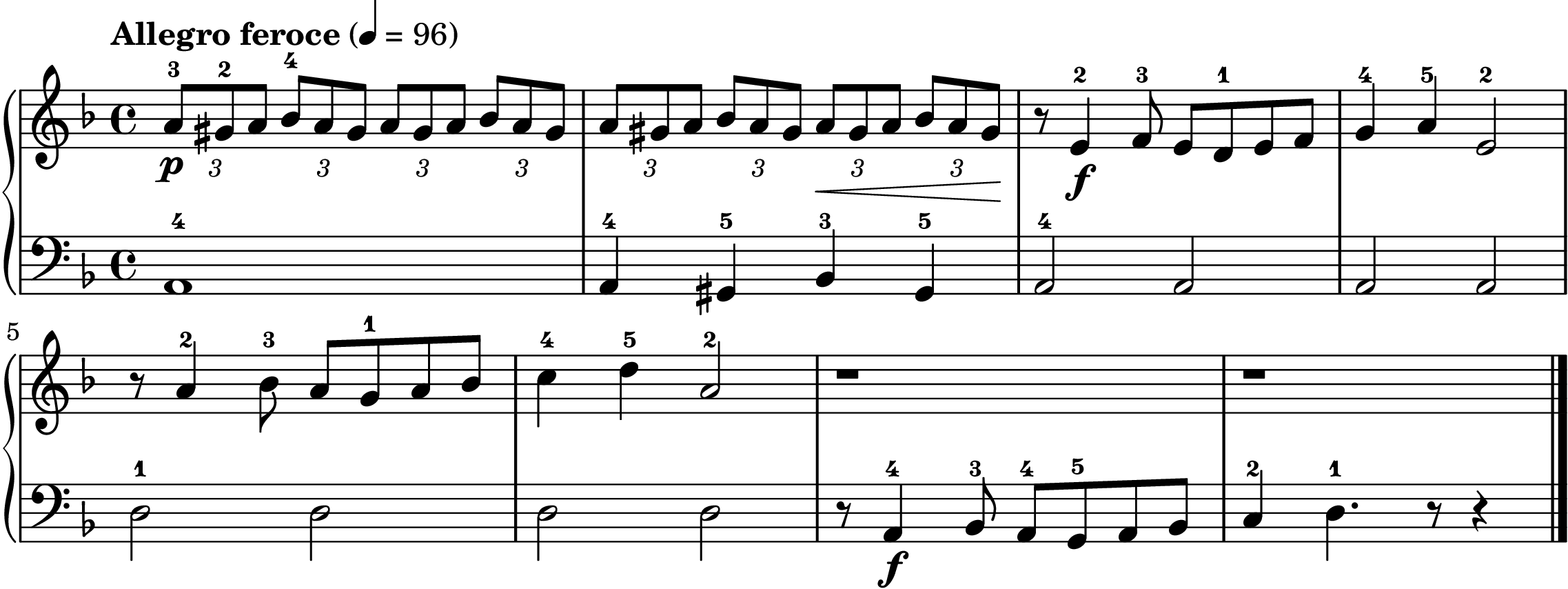
Drill Section A at x0.5 on the player: these are the orchestra's own notes, in the original D minor. First the strings' whirl, A4-G sharp 4-A4-B flat 4-A4-G sharp 4 in triplets on fingers 3-2-3-4-3-2. Then the main theme, starting just after the beat: E4-F4-E4-D4-E4-F4, G4-A4, a long E4, and a fourth higher, A4-B flat 4-A4-G4-A4-B flat 4, C5-D5, A4. In measures 7-8 the right hand rests and the left hand plays the theme alone in the bass.
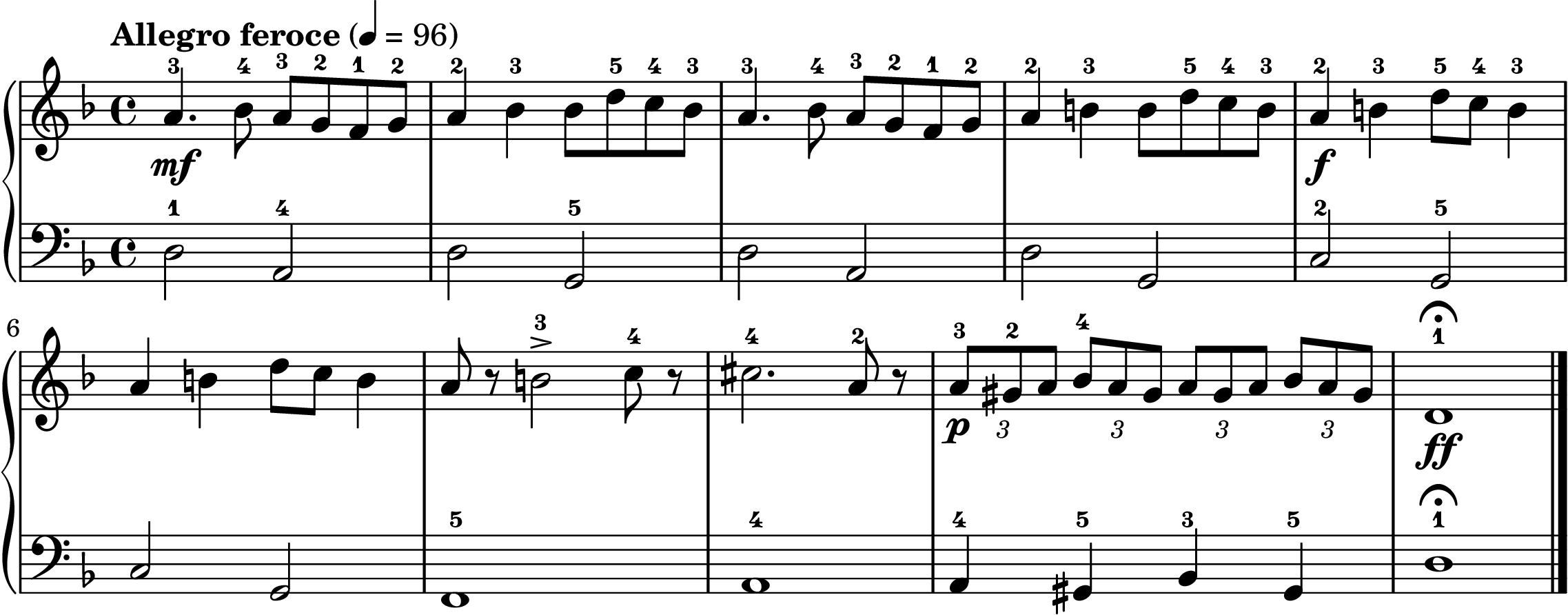
Section B brings the broader second theme: A4, B flat 4-A4-G4-F4-G4, then A4, B flat 4, B flat 4-D5-C5-B flat 4, repeated with B natural. It climbs A4-B4-D5-C5-B4 twice, holds B4, and stops on a long C sharp 5; then the whirl returns quietly and both hands land on D. Thumb on F4 in measures 9 and 11, on G4 in measures 10 and 12 to 16.
The full score
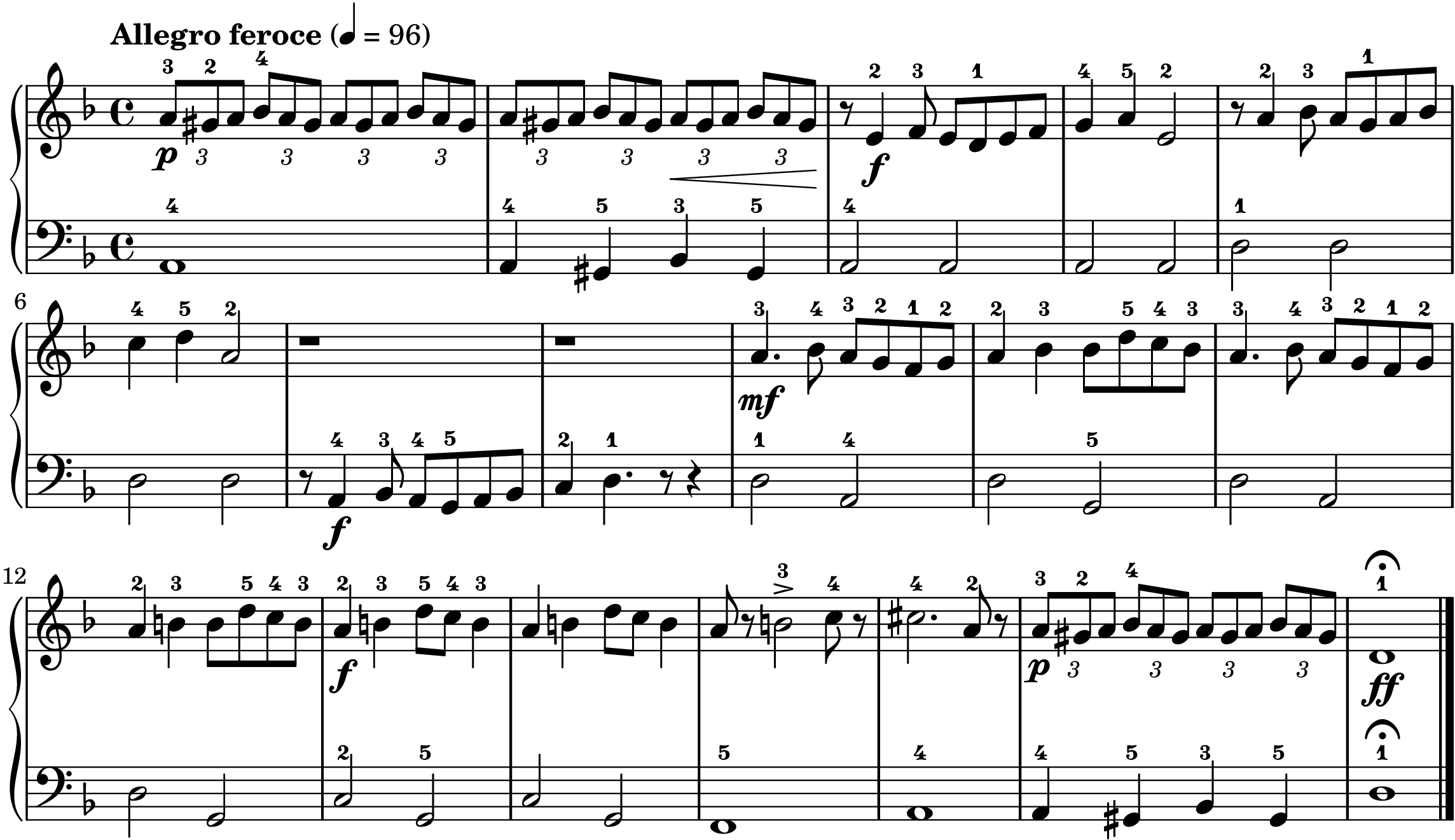
Allegro feroce means fast and ferocious. At 96 BPM the quarter notes are steady enough to keep the triplet whirl light and even; play the themes with a firm forte, and save the biggest sound for the final D.
Note by note: keys and fingering
- Right hand: Three positions. The whirl and the second theme: thumb on F4, G sharp 4 under the index (2), A4 under the middle finger (3), B flat 4 under the ring finger (4). The main theme: thumb on D4 for E4-F4-E4-D4-E4-F4-G4-A4 (fingers 1 to 5), then thumb on G4 for A4-B flat 4-A4-G4-A4-B flat 4-C5-D5 (fingers 1 to 5); the same G position carries B4, C sharp 5 and the cadence. The finger table shows the main fingering for each note.
- Left hand: Single notes in one position: pinky (5) on G2 or G sharp 2, ring (4) on A2, middle (3) on B flat 2, index (2) on C3, thumb (1) on D3. Measures 7-8 are a left-hand solo of the main theme, and measure 15 stretches the pinky down to F2.
| Note | On the Staff | On the Keyboard | Finger |
|---|---|---|---|
| A4 | Second space of treble staff | White key between the last two of three black keys | RH Middle (3) |
| G#4 | Second line of treble staff, with a sharp sign | Middle black key of the three | RH Index (2) |
| Bb4 | Middle line of treble staff (flat in the key signature) | Last black key of the three | RH Ring (4) |
| D4 | Just below the bottom line of treble staff | White key between the two black keys above middle C | RH Thumb (1) |
| E4 | Bottom line of treble staff | White key right of the two black keys above middle C | RH Index (2) |
| F4 | First space of treble staff | White key left of the three black keys | RH Thumb (1) |
| G4 | Second line of treble staff | White key between the first two of three black keys | RH Index (2) |
| B4 | Middle line of treble staff, with a natural sign | White key right of the three black keys | RH Middle (3) |
| C5 | Third space of treble staff | White key left of the two black keys above middle C | RH Ring (4) |
| C#5 | Third space of treble staff, with a sharp sign | First black key of the two above C5 | RH Ring (4) |
| D5 | Fourth line of treble staff | White key between the two black keys above C5 | RH Pinky (5) |
| A2 | First space of bass staff | White key between the last two of three black keys, two octaves down | LH Ring (4) |
| G#2 | Bottom line of bass staff, with a sharp sign | Middle black key of the three, two octaves down | LH Pinky (5) |
| Bb2 | Second line of bass staff (flat in the key signature) | Last black key of the three, two octaves down | LH Middle (3) |
| G2 | Bottom line of bass staff | White key between the first two of three black keys, two octaves down | LH Pinky (5) |
| C3 | Second space of bass staff | White key left of the two black keys below middle C | LH Index (2) |
| D3 | Middle line of bass staff | White key between the two black keys below middle C | LH Thumb (1) |
| F2 | Space below the bass staff | White key left of the three black keys, two octaves down | LH Pinky (5) |
Prefer a video? Watch the keys light up
Same color code as the player: green marks the right hand, blue the left hand, with the score and keyboard in one vertical video.
The story behind Night on Bald Mountain
Modest Mussorgsky wrote the first version of Night on Bald Mountain in 1867, but it is not the one orchestras play. After his death in 1881, Nikolai Rimsky-Korsakov completed and orchestrated the piece, and V. Bessel & Co. printed his score in St. Petersburg in 1886; its third page says so in plain words. Konstantin Chernov later made a piano version of it for the same publisher, and we read both prints note by note. Disney's Fantasia (1940) used Leopold Stokowski's own arrangement, which is still protected, so none of it is here. Our version keeps Rimsky-Korsakov's real themes in his D minor, over a simple single-note left hand.
Get the printable PDF
The printable PDF of this easy Night on Bald Mountain theme - full score, hand positions, and a step-by-step practice guide - ships inside our free Halloween pack together with fourteen other spooky pieces.
Ferocious forte playing needs a bench that will not budge, and an Adjustable Piano Bench with Back Support gives you a firm, height-matched base for all that pounding.
Piano teacher? Track your students' practice. Join the early list
FAQ
How hard is Night on Bald Mountain on piano?
The orchestral work is a monster. This arrangement is Level 3 of our Halloween collection. It plays Rimsky-Korsakov's themes in the original D minor at 96 BPM, with a triplet whirl, three right-hand positions and a few accidentals (G sharp, B natural, C sharp). The left hand plays single notes only.
How long does it take to learn Night on Bald Mountain?
Expect two to three weeks. The main theme is two short phrases, and the second is the first moved up a fourth. Most of the practice goes into an even triplet whirl and into starting the theme just after the beat while the left hand plays on it.
What level is Night on Bald Mountain?
Level 3 of our Halloween collection, the Midnight Classics. It asks for triplets, off-beat entries, three hand positions with clear shifts, a left-hand solo in measures 7 and 8, and dynamics from piano to fortissimo.
What are the notes for Night on Bald Mountain?
The whirl is A4, G sharp 4, A4, B flat 4, A4, G sharp 4 in triplets. The main theme is E4, F4, E4, D4, E4, F4, G4, A4, E4, then A4, B flat 4, A4, G4, A4, B flat 4, C5, D5, A4; the left hand then echoes that second phrase two octaves lower. The second theme runs A4, B flat 4, A4, G4, F4, G4, then A4, B flat 4, B flat 4, D5, C5, B flat 4, and the piece ends on D. Full table above.