
Jingle Bells is the most famous holiday tune ever written, and this easy C major version starts with the interactive player below: hear the chorus at half speed, watch the notes and keys light up, and drag the score to replay any bar. Sheet music, full fingering, and a free printable PDF come next.
Learn it with the interactive player
- Slow it down: x0.5 or x0.75 while you learn the notes, back to x1 once they flow.
- Pause anywhere: the current keys stay lit so you can find them on your own piano.
- Drag the score left or right, or use the 15s buttons, to replay a phrase.
The sheet music, section by section

Take Section A first, right hand alone: the chorus E-E-E, E-E-E, E-G-C-D-E. Set the player above to x0.5, keep the repeated E notes perfectly even, and only then add the jump down to C and back up to G.

Section B is the verse, climbing to F-F-F-F-F-E-E before the resolution. The F and G bass changes arrive here, so practice measures 13-16 on their own before joining them to the rest.
The full score
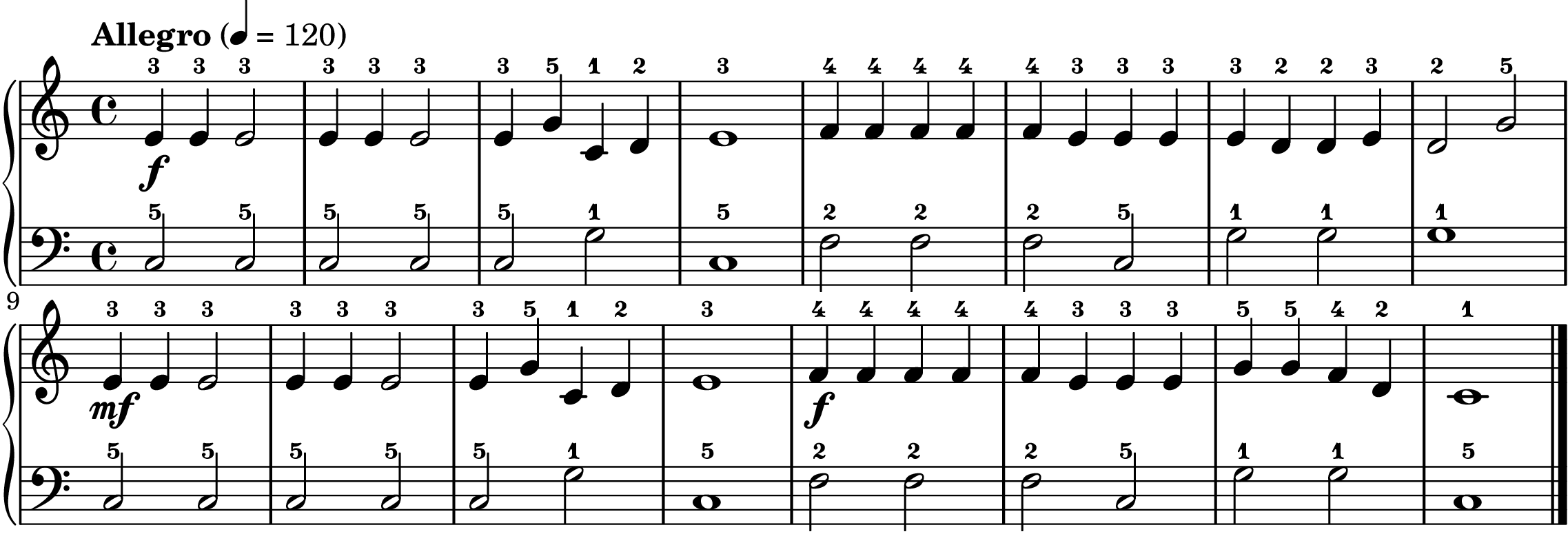
Once chorus and verse are both comfortable, run the full score with a light, bouncy staccato and build gradually toward the 120 BPM Allegro.
Note by note: keys and fingering
- Right hand: C4, D4, E4, F4, G4 - Standard C position. The chorus mostly stays on E, with jumps to C and G.
- Left hand: C3, F3, G3 - C, F, and G bass notes following the chord changes.
| Note | On the Staff | On the Keyboard | Finger |
|---|---|---|---|
| C4 (Middle C) | One ledger line below treble staff | White key left of two black keys, center | RH Thumb (1) |
| D4 | Just below bottom line of treble staff | Between the two black keys | RH Index (2) |
| E4 | On the bottom line of treble staff | Right of two black keys | RH Middle (3) |
| F4 | First space of treble staff | Left of three black keys | RH Ring (4) |
| G4 | Second line of treble staff | Between first two of three black keys | RH Pinky (5) |
| C3 | Two ledger lines below bass staff | One octave below middle C | LH Pinky (5) |
| F3 | Fourth space of bass staff | Left of three black keys, below middle C | LH Index (2) |
| G3 | Top line of bass staff | Between first two of three black keys | LH Thumb (1) |
Prefer a video? Watch the keys light up
Same color code as the player: green marks the right hand, blue the left hand, with the score and keyboard in one vertical video.
The story behind Jingle Bells
Jingle Bells was written by James Lord Pierpont and published in 1857 under its original title, One Horse Open Sleigh. Pierpont composed it in Savannah, Georgia, where it was reportedly first performed for a Thanksgiving celebration at his church - only later did it become permanently attached to Christmas. More than a century on, it earned another first: in December 1965, the astronauts of Gemini 6 smuggled a harmonica and sleigh bells aboard and played it in orbit, making it the first song performed in space. The chorus is built on a handful of repeated notes, which is exactly why it makes such a rewarding early piano piece.
Get the printable PDF
The printable PDF of Jingle Bells - full score, hand positions, and a step-by-step practice guide - ships inside our free Level 1 pack together with four other first pieces.
Bouncy staccato playing is easier when kids sit steady, which is exactly what a Classic Piano Bench for kids and a piano pedal extender are made for.
FAQ
How hard is Jingle Bells on piano?
The chorus is very approachable - a Level 1 piece built almost entirely on repeated E notes with a few jumps to C and G. The verse adds F and a G bass change, which is the only spot that takes real coordination practice. Everything fits in one five-finger C position.
How long does it take to learn Jingle Bells?
Most beginners get the chorus going within a few days, since it is mostly E-E-E patterns. Plan on two to three weeks to play all 16 measures hands together at a comfortable tempo, with the F to G bass change in the verse taking the most repetition.
What level is Jingle Bells?
It belongs to the Level 1 pack of our free sheet collection, in C major, 4/4 time, with an Allegro target of 120 BPM. The right hand covers C4 to G4 and the left hand uses three bass notes: C3, F3, and G3.
What are the notes for Jingle Bells on piano?
The chorus runs E-E-E, E-E-E, E-G-C-D-E - the repeated E notes create the jingle effect. The verse moves higher with F-F-F-F-F-E-E before resolving. The left hand follows the chords with C, F, and G bass notes; the full table with fingerings is above.