
In the Hall of the Mountain King is Grieg’s tiptoeing troll march, and the interactive player below is the place to start: run it at half speed, watch the notes and keys light up as it plays, and drag the score to loop any measure. The sheet music, fingering, and a free printable PDF come next.
Learn it with the interactive player
- Slow it down: x0.5 or x0.75 while you learn the notes, back to x1 once they flow.
- Pause anywhere: the current keys stay lit so you can find them on your own piano.
- Drag the score left or right, or use the 15s buttons, to replay a phrase.
The sheet music, section by section
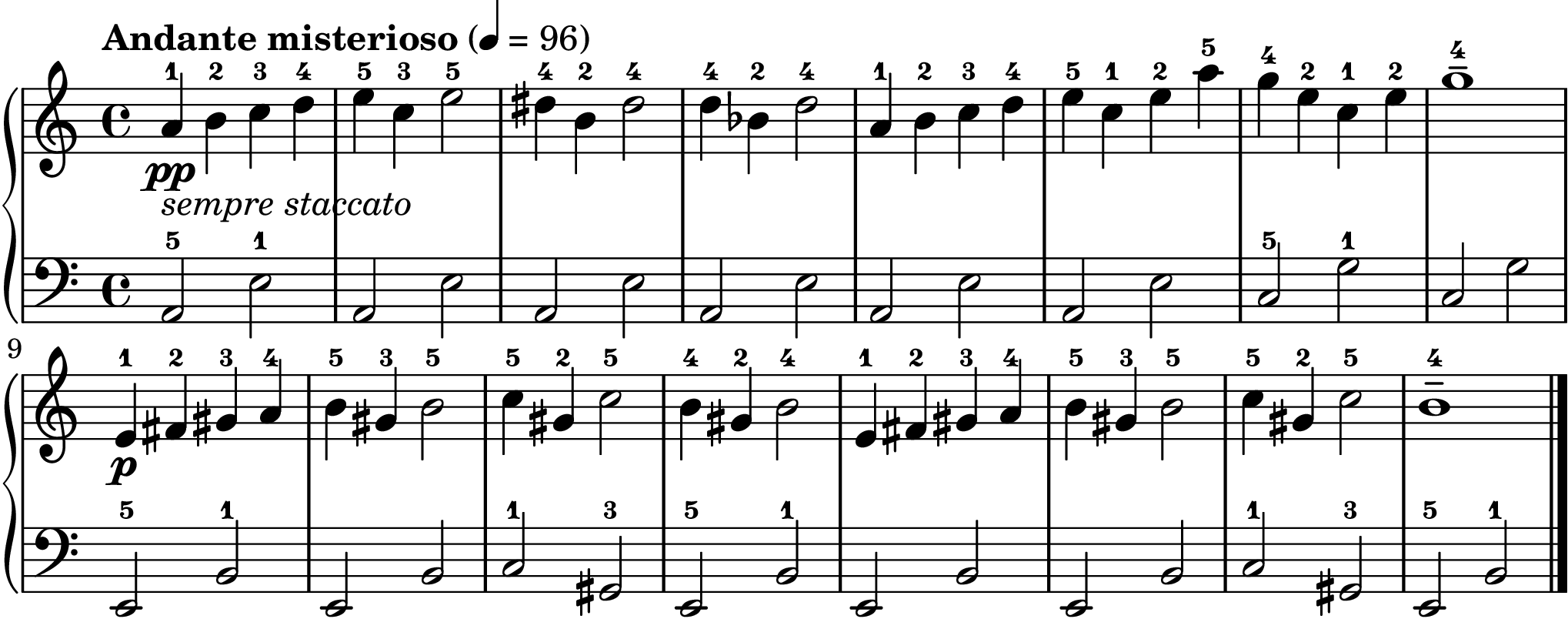
Learn Section A at x0.5 on the player: the theme creeps up A4-B4-C5-D5, leaps E5-C5-E5, then slinks onto the black keys D sharp 5 and B-flat 4 before climbing again to a high A5, all pianissimo, like footsteps you are not supposed to hear. In measure 9 the hand drops to E4 for a middle phrase with G sharp 4, played twice and a little louder.
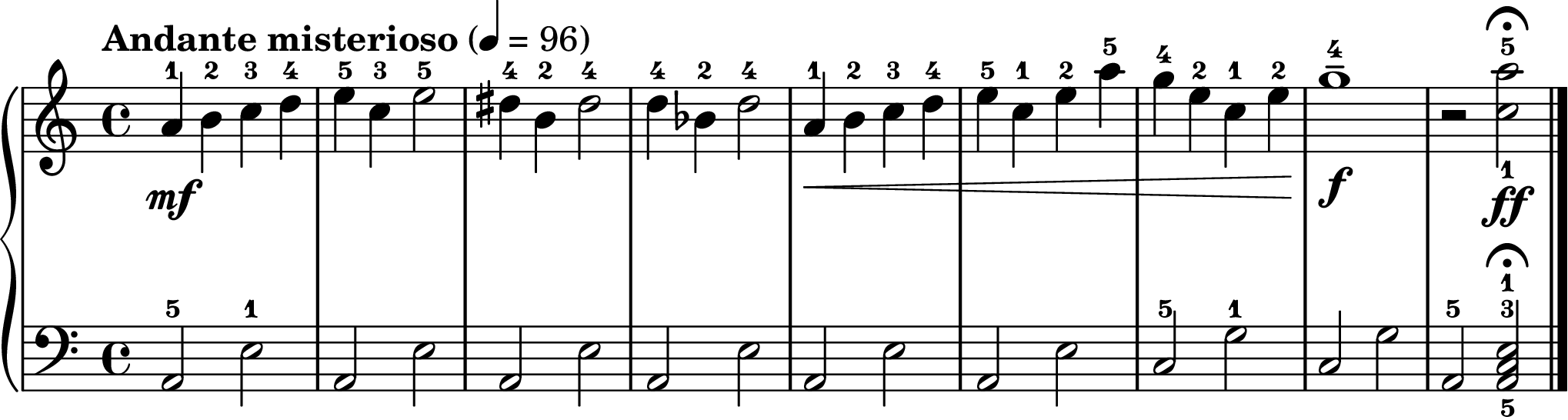
Section B brings the theme back mezzo-forte, swells to forte on the long G5, and closes with one fortissimo chord, C5 and A5 over A2-C3-E3.
The full score
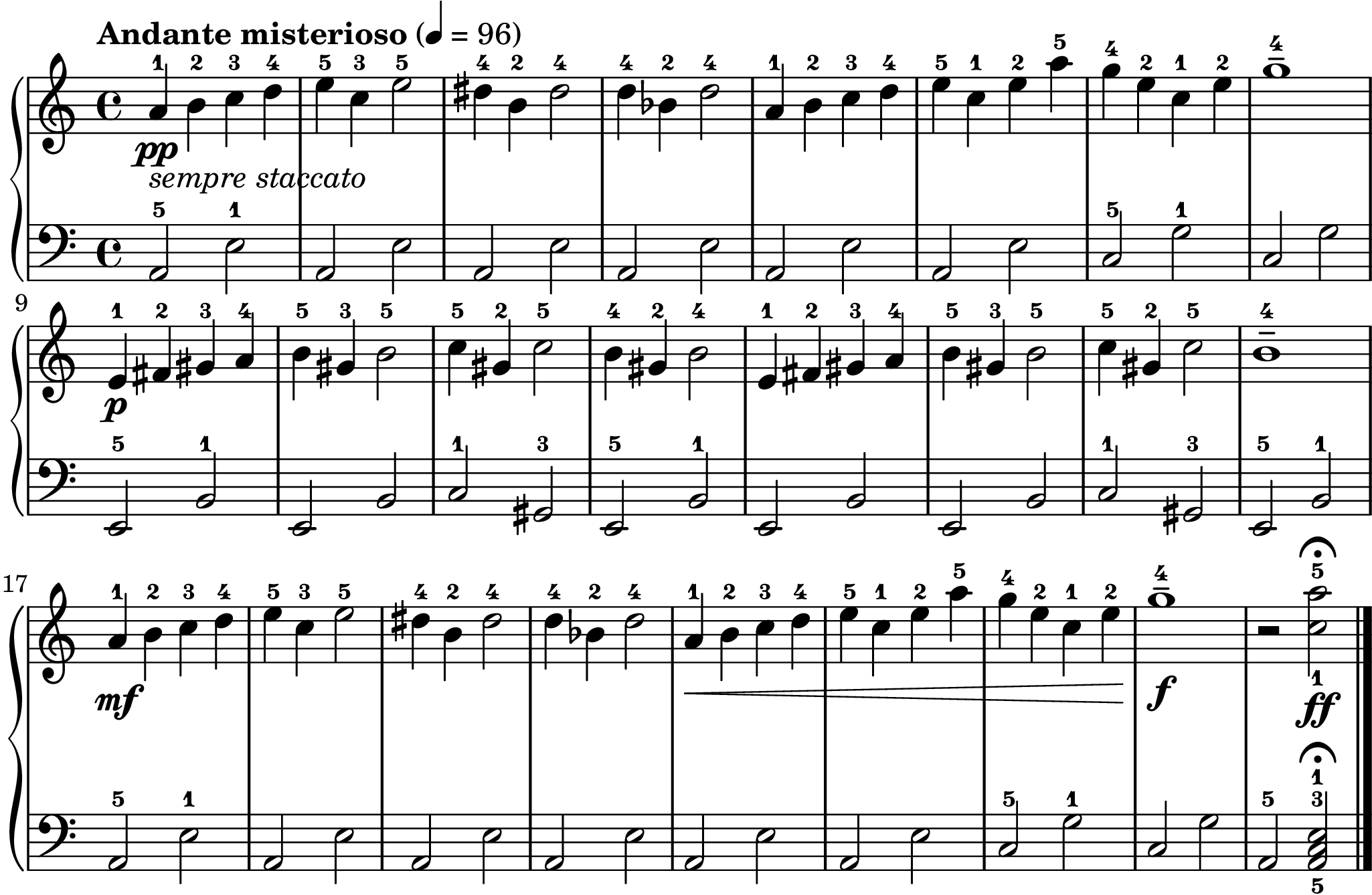
The original accelerates to a frenzy, but beginners should hold the full score steady at 96 BPM and build the storm with dynamics alone, from pp whispers to the ff chord in the last measure.
Note by note: keys and fingering
- Right hand: The theme starts in the A position: thumb (1) on A4 up to the pinky (5) on E5, with the ring finger (4) on D5 and the chromatic D#5, and the index (2) on B4 and B-flat 4. In the rising answer the thumb moves up to C5, so E5 takes 2, A5 the pinky (5) and G5 the ring finger (4). The middle phrase drops to an E position from E4 (1), where A4 takes 4, G#4 takes 3 or 2, C5 the pinky (5), and B4 the pinky or the ring finger (4). In the final chord, C5 takes the thumb (1) and A5 the pinky (5).
- Left hand: Root-and-fifth half notes taken from Grieg's bass: pinky (5) on A2 and thumb (1) on E3 under the theme, C3 (5) and G3 (1) under its long G5, E2 (5) and B2 (1) in the middle phrase, where measures 11 and 15 shift to C3 (1) and G#2 (3). The piece ends on an A2-C3-E3 chord (5-3-1).
| Note | On the Staff | On the Keyboard | Finger |
|---|---|---|---|
| A4 | Second space of treble staff | White key between the last two of three black keys | RH Thumb (1) |
| B4 | Third line of treble staff | White key right of the three black keys | RH Index (2) |
| C5 | Third space of treble staff | White key left of the two black keys above middle C | RH Middle (3) |
| D5 | Fourth line of treble staff | White key between the two black keys above C5 | RH Ring (4) |
| E5 | Fourth space of treble staff | White key right of the two black keys above C5 | RH Pinky (5) |
| D#5 | Fourth line of treble staff, with a sharp sign | Black key right of D5 | RH Ring (4) |
| Bb4 | Third line of treble staff, with a flat sign | Black key left of B4 | RH Index (2) |
| G5 | Space above the treble staff | White key between the first two of three black keys above C5 | RH Ring (4) |
| A5 | First ledger line above the treble staff | White key between the last two of three black keys above C5 | RH Pinky (5) |
| E4 | First line of treble staff | White key right of the two black keys above middle C | RH Thumb (1) |
| F#4 | First space of treble staff, with a sharp sign | Black key right of F4 | RH Index (2) |
| G#4 | Second line of treble staff, with a sharp sign | Black key right of G4 | RH Middle (3) |
| A2 | First space of bass staff | White key between the last two of three black keys, two octaves down | LH Pinky (5) |
| E3 | Third space of bass staff | White key right of the two black keys below middle C | LH Thumb (1) |
| C3 | Second space of bass staff | White key left of the two black keys below middle C | LH Pinky (5) |
| G3 | Fourth space of bass staff | White key between the first two of three black keys below middle C | LH Thumb (1) |
| E2 | First ledger line below the bass staff | White key right of the two black keys, below A2 | LH Pinky (5) |
| B2 | Second line of bass staff | White key right of the three black keys, two octaves down | LH Thumb (1) |
| G#2 | Bottom line of bass staff, with a sharp sign | Black key right of G2 | LH Middle (3) |
Prefer a video? Watch the keys light up
Same color code as the player: green marks the right hand, blue the left hand, with the score and keyboard in one vertical video.
The story behind the Mountain King theme
Edvard Grieg wrote In the Hall of the Mountain King in 1875 as incidental music for Henrik Ibsen's play Peer Gynt, where Peer sneaks into the underground hall of the troll king and is chased by his court. Grieg begins the theme at a whisper in the low strings and repeats it faster and louder until the orchestra erupts - a crescendo he privately joked reeked of cow pies and Norwegian-ness, though audiences adored it. Published in the first Peer Gynt Suite in 1888, it became one of the most recognized minor-key themes ever written, endlessly borrowed by films and cartoons. Our A minor arrangement follows Grieg's own piano version of the suite, cut to the theme, its middle phrase and the final chord.
Get the printable PDF
The printable PDF of this easy Mountain King theme - full score, hand positions, and a step-by-step practice guide - ships inside our free Halloween pack together with fourteen other spooky pieces.
A crescendo this long is easier to control from a solid base, and an Adjustable Piano Bench with Back Support keeps you planted as the troll march grows louder.
Piano teacher? Track your students' practice. Join the early list
FAQ
How hard is In the Hall of the Mountain King on piano?
The famous accelerating original is a real workout, but this steady-tempo arrangement opens Level 3 of our Halloween collection. The right hand runs from E4 up to A5 in quarters, halves and whole notes, with four black keys (D sharp 5, B-flat 4, F sharp 4, G sharp 4), over a left hand of slow root-and-fifth half notes.
How long does it take to learn In the Hall of the Mountain King?
One to two weeks for the notes, since the eight-measure theme comes twice, around a middle phrase on E, before a one-chord ending. Most of the practice then goes into dynamics, playing the theme pianissimo first and mezzo-forte on its return, then growing to forte without rushing.
What level is In the Hall of the Mountain King?
Level 3 of our Halloween collection, the Midnight Classics. It earns that placement with its black keys, two hand moves (the thumb shifting up to C5 so the pinky reaches A5, and the drop to E4 for the middle phrase), and the discipline of a written crescendo at a fixed 96 BPM.
What are the notes for In the Hall of the Mountain King?
The theme climbs A4, B4, C5, D5, then E5, C5, E5, and its creeping answer is D sharp 5, B4, D sharp 5, then D5, B-flat 4, D5. In the second half it climbs A4 to D5 again, leaps E5, C5, E5, A5 and comes down G5, E5, C5, E5 to a long G5. The middle phrase runs E4, F sharp 4, G sharp 4, A4, then B4, G sharp 4, B4, C5, G sharp 4, C5, B4, G sharp 4, B4, and repeats, ending on a long B4. Under all this the left hand plays A2 and E3, C3 and G3, then E2 and B2 with C3 and G sharp 2, ending on A2, C3, E3 under C5 and A5. Full table above.