
Ode to Joy is Beethoven’s great melody from the Ninth Symphony, and this easy C major version is built around the interactive player below: hear it at half speed, watch the notes and keys light up, and drag the score to replay any phrase. Sheet music, fingering, and a free printable PDF follow.
Learn it with the interactive player
- Slow it down: x0.5 or x0.75 while you learn the notes, back to x1 once they flow.
- Pause anywhere: the current keys stay lit so you can find them on your own piano.
- Drag the score left or right, or use the 15s buttons, to replay a phrase.
The sheet music, section by section

Begin with Section A, right hand alone: the stepwise line E-E-F-G-G-F-E-D, then C-C-D-E and the long E-D-D. Set the player above to x0.5 and read along - every note moves by step, so aim for perfect legato from the very first pass.

Section B starts exactly like the first phrase but resolves to C instead of D. Practice the closing E-D-C on its own until the landing feels inevitable, then rejoin it to the full phrase.
The full score
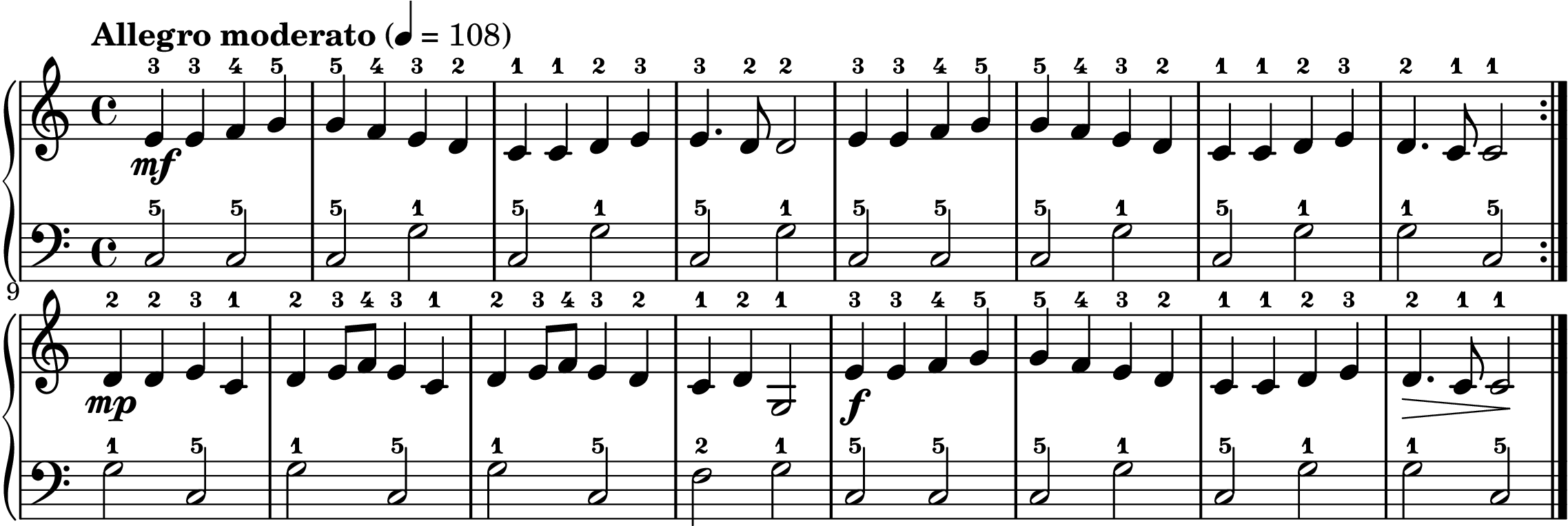
With both phrases secure, play the full score slowly and line the half-note bass changes up with the melody before building toward the 108 BPM target.
Note by note: keys and fingering
- Right hand: C4, D4, E4, F4, G4 - Standard C position: thumb on C, pinky on G. The melody stays within this five-finger range.
- Left hand: C3, E3, G3 - Pinky on C3, middle finger on E3, thumb on G3. Simple half-note patterns.
| Note | On the Staff | On the Keyboard | Finger |
|---|---|---|---|
| C4 (Middle C) | One ledger line below treble staff | White key left of two black keys, center | RH Thumb (1) |
| D4 | Just below bottom line of treble staff | Between the two black keys | RH Index (2) |
| E4 | On the bottom line of treble staff | Right of two black keys | RH Middle (3) |
| F4 | First space of treble staff | Left of three black keys | RH Ring (4) |
| G4 | Second line of treble staff | Between first two of three black keys | RH Pinky (5) |
| C3 | Two ledger lines below bass staff | One octave below middle C | LH Pinky (5) |
| E3 | Fourth line of bass staff (from bottom) | Right of two black keys, below middle C | LH Middle (3) |
| G3 | Top line of bass staff | Between first two of three black keys | LH Thumb (1) |
Prefer a video? Watch the keys light up
Same color code as the player: green marks the right hand, blue the left hand, with the score and keyboard in one vertical video.
The story behind Ode to Joy
The Ode to Joy theme closes Beethoven's Symphony No. 9, completed in 1824, where a full choir sings words adapted from Friedrich Schiller's 1785 poem An die Freude. By then Beethoven was almost completely deaf: at the Vienna premiere he reportedly had to be turned around to see the audience applauding, because he could not hear them. The melody's power lies in its simplicity - it moves almost entirely by step within a five-note range, which is why it works so well as an early piano piece. In 1985 the theme was adopted as the official anthem of Europe, carrying Schiller's message of universal brotherhood around the world.
Get the printable PDF
The printable PDF of this easy Ode to Joy - full score, hand positions, and a step-by-step practice guide - ships inside our free Level 1 pack together with four other first pieces.
If a young Beethoven fan is doing the practicing, a Classic Piano Bench for kids at the right height and a piano pedal extender under their feet make daily sessions much more comfortable.
FAQ
How hard is Ode to Joy on piano?
This arrangement is one of the easiest classical themes there is - a Level 1 piece in our collection. The right hand stays in a five-finger C position from C4 to G4 and moves entirely by step, while the left hand plays simple half-note patterns on C3, E3, and G3.
How long does it take to learn Ode to Joy?
Most beginners can play the melody alone within a week and hands together in two to three weeks of short daily sessions. Because the tune moves only in steps, with no jumps at all, the fingers never have to leave their home keys.
What level is Ode to Joy?
The easy version on this page sits in our Level 1 pack: one hand position, a stepwise melody, and a half-note accompaniment. It is played in C major, in 4/4, at an Allegro moderato around 108 BPM. Beethoven's orchestral original is, of course, another matter entirely.
What are the notes for Ode to Joy on piano?
The theme begins E-E-F-G-G-F-E-D, then C-C-D-E followed by the long E-D-D. The second phrase starts identically but closes with E-D-C, resolving to the home note. The left hand supports with C, G, F, and C chord roots in half notes; the full table is above.