
The Swan Lake theme is Tchaikovsky’s haunted oboe call over a moonlit lake, and this easy A minor version begins at the interactive player below: hear it at half speed, watch the notes and keys light up, and drag the score to any measure. Sheet music, fingering, and a free printable PDF follow.
Learn it with the interactive player
- Slow it down: x0.5 or x0.75 while you learn the notes, back to x1 once they flow.
- Pause anywhere: the current keys stay lit so you can find them on your own piano.
- Drag the score left or right, or use the 15s buttons, to replay a phrase.
The sheet music, section by section

Play Section A at x0.5 on the player. The left hand opens alone for one measure, then the oboe tune enters softly on a half-note E5 and runs A4-B4-C5-D5 back up to it. Measure 4 needs the most care: E5-A4-C5-A4-F4-C5 carries the hand down so the thumb lands on F4, and on the held A4 that follows you switch from finger 3 to 1.
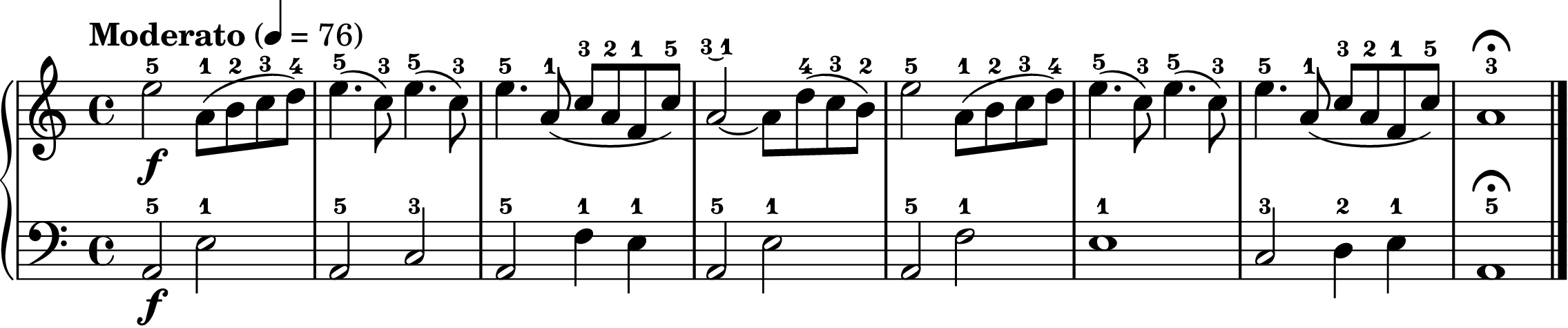
Section B plays the same eight measures again, forte. Tchaikovsky brings the tune back later in the scene, marked f marcato, and this arrangement keeps that return. Keep the dotted E5-C5 swings exact at the louder volume, and let the last A4 ring under its fermata.
The full score
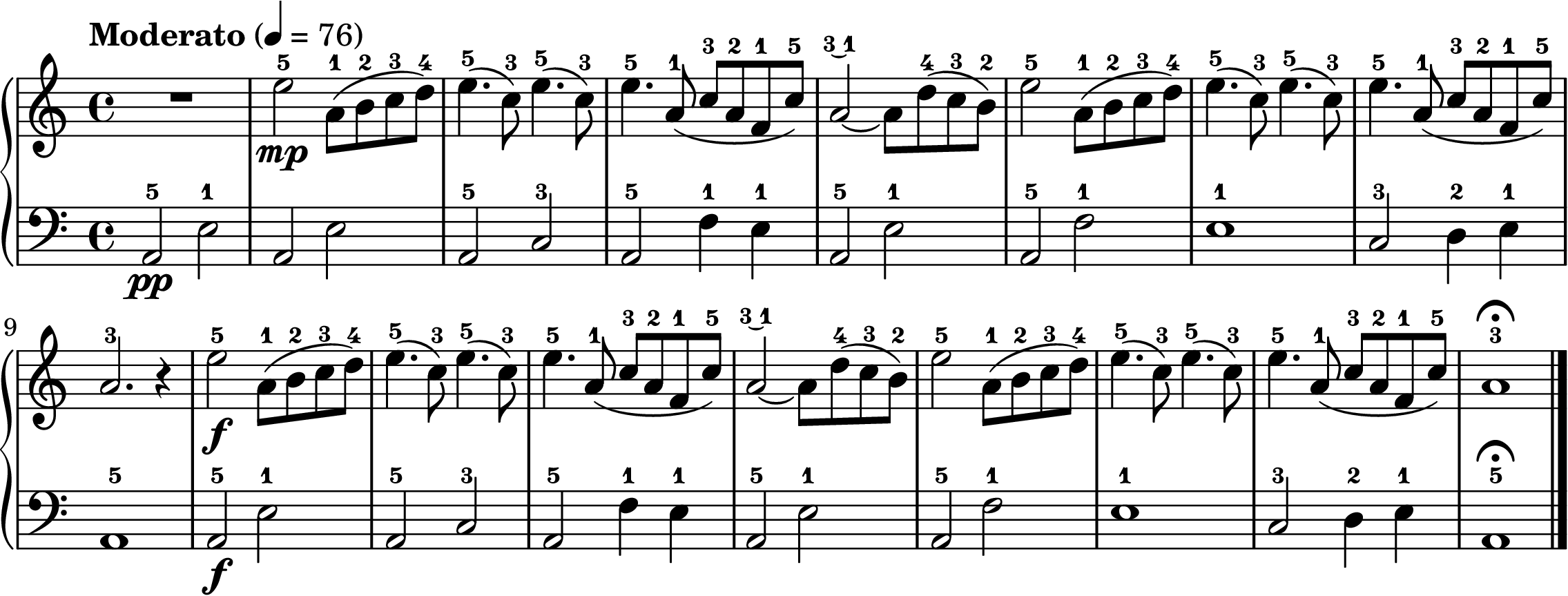
Hold the full score at a flowing Moderato, 76 beats per minute, in both sections. The change from mp in Section A to forte in Section B carries the drama, so leave the tempo alone.
Note by note: keys and fingering
- Right hand: The oboe tune starts in the A position: thumb (1) on A4, then B4 (2), C5 (3), D5 (4), and the pinky (5) on E5. In measures 4, 8, 12 and 16 the falling figure E5-A4-C5-A4-F4-C5 (5-1-3-2-1-5) moves the hand down two white keys into the F position, so the thumb takes F4 and the pinky C5. On the held A4 in measures 5 and 13, change silently from 3 to 1 to get back into the A position.
- Left hand: Single bass notes, mostly half notes: pinky (5) on A2, middle (3) on C3, index (2) on D3, thumb (1) on E3, and the thumb also reaches F3 and comes back. Measure 1 is the left hand alone.
| Note | On the Staff | On the Keyboard | Finger |
|---|---|---|---|
| E5 | Fourth space of treble staff | White key right of the two black keys above C5 | RH Pinky (5) |
| A4 | Second space of treble staff | White key between the last two of three black keys | RH Thumb (1) |
| B4 | Third line of treble staff | White key right of the three black keys | RH Index (2) |
| C5 | Third space of treble staff | White key left of the two black keys above middle C | RH Middle (3) |
| D5 | Fourth line of treble staff | White key between the two black keys above C5 | RH Ring (4) |
| F4 | First space of treble staff | White key left of the three black keys | RH Thumb (1) |
| A2 | First space of bass staff | White key between the last two of three black keys, two octaves down | LH Pinky (5) |
| C3 | Second space of bass staff | White key left of the two black keys below middle C | LH Middle (3) |
| D3 | Middle line of bass staff | White key between the two black keys below middle C | LH Index (2) |
| E3 | Third space of bass staff | White key right of the two black keys below middle C | LH Thumb (1) |
| F3 | Fourth line of bass staff | White key left of the three black keys below middle C | LH Thumb (1) |
Prefer a video? Watch the keys light up
Same color code as the player: green marks the right hand, blue the left hand, with the score and keyboard in one vertical video.
The story behind the Swan Lake theme
Pyotr Tchaikovsky composed Swan Lake between 1875 and 1876, and the ballet premiered at Moscow's Bolshoi Theatre in 1877 to a famously lukewarm reception. The now-iconic swan theme belongs to Odette, a princess transformed into a swan by the sorcerer Rothbart; Tchaikovsky gives it to a solo oboe over shimmering strings each time the swans appear at the lake. Only after the composer's death in 1893 did the 1895 St. Petersburg revival turn the ballet into a repertory cornerstone. The theme's eerie, moonlit character earns its place in this collection; our arrangement moves it from B minor to A minor and plays the oboe's tune twice, soft and then forte, as the scene itself does.
Get the printable PDF
The printable PDF of this easy Swan Lake theme - full score, hand positions, and a step-by-step practice guide - ships inside our free Halloween pack together with fourteen other spooky pieces.
Long held notes reveal any slouch, and an Adjustable Piano Bench with Back Support keeps your back supported while the swan glides through its phrases.
Piano teacher? Track your students' practice. Join the early list
FAQ
How hard is Swan Lake on piano?
The full ballet score is orchestral, and concert transcriptions are advanced. This theme arrangement sits in Level 2 of our Halloween collection: the right hand plays white keys only, from F4 up to E5, the left hand plays single bass notes, and the trickiest spot is the falling figure where the hand moves down into the F position to reach F4 with the thumb.
How long does it take to learn Swan Lake?
Most Level 2 learners play this arrangement comfortably within one to two weeks. Section B repeats the tune of Section A note for note, only louder and ending on a held A4, so there are eight measures of melody to learn, and most of the practice goes into the dotted E5-C5 rhythm and the eighth-note runs.
What level is Swan Lake?
Level 2 of our Halloween collection, where the left hand starts walking between bass notes while the right hand sings. Here the left hand plays mostly half notes on A2, C3, D3, E3, and F3, while the melody adds eighth notes and one small move below the five-finger position.
What are the notes for the Swan Lake theme?
After one measure of left hand alone, the theme holds E5 for two beats, runs A4, B4, C5, D5 back to E5, then swings E5, C5, E5, C5. It falls E5, A4, C5, A4, F4, C5, rests on A4, and D5, C5, B4 lead into the second phrase, which ends on a long A4. The left hand plays A2, C3, D3, E3, and F3. The full table is above.